Your compatibility —what really happens between two charts
Compare two natal charts in 2 minutes: enter both birth details and the AI astrologer reads your synastry — the chemistry, the strengths and the friction points. Free.
It described our relationship better than we could
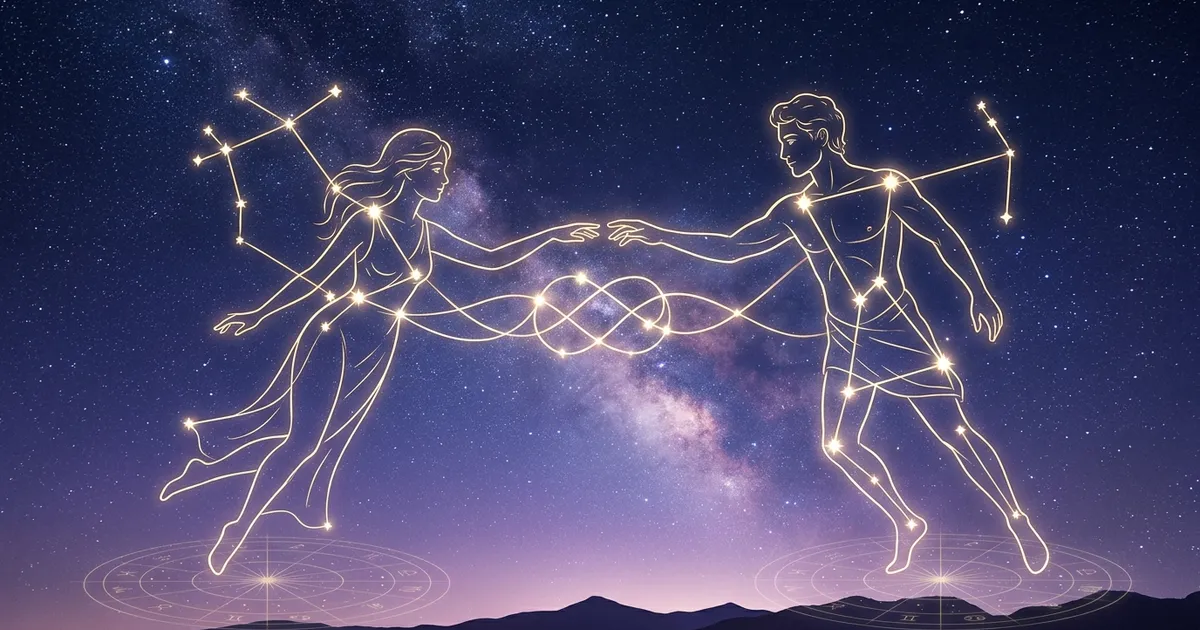
—You looked up your sun signs — but 'Aries and Libra' tells you nothing about the two of you?
—You feel a real connection but also recurring friction, and you can't explain why?
—You want to know where you click and where you clash — before you keep guessing?
Two charts, every angle between them
Synastry compares both natal charts to show how your energies actually meet
Sun & Moon contacts
How your core identities and emotional needs align — the foundation of whether you feel truly seen by each other.
Venus & Mars chemistry
The planets of love and desire reveal your attraction, romantic style and physical spark together.
Mercury connection
How you communicate, think and 'get' each other in everyday conversation — or where you keep talking past one another.
Strengths of the bond
The supportive aspects that make you flow easily, feel safe and bring out the best in each other.
Friction points
The tension aspects worth knowing about — not red flags, but the places that need awareness and care.
AI synastry reading
Every contact between your charts turned into a clear, personal reading of your relationship — no jargon, no templates.
Add both birth details — we'll show you how your charts meet
Enter both birth details
Date, exact time and place of birth for each of you — that's all we need to calculate both charts
We compare the charts
Professional calculations (Swiss Ephemeris, 0.001°) map every aspect between you, and the AI interprets your synastry — not a template, a reading of your specific connection
Get your reading
Chemistry, strengths, friction points and growth areas for the relationship — all in one place
Astrollo AI vs sun-sign compatibility
| Astrollo AI | Regular services | |
|---|---|---|
| Calculation accuracy | Swiss Ephemeris, 0.001° | Simplified tables |
| What's compared | Both full charts: planets, houses, aspects | Two sun signs only |
| Personalization | Date + time + place for both people | Star signs only |
| AI reading | Personal interpretation of your synastry | Generic 'Aries + Libra' text |
| Interactivity | Ask the AI about your relationship | Static result |
Zodiac Compatibility by Birth Date: What Your Charts Reveal
Zodiac compatibility by birth date compares two people's astrological charts to show where your energies flow easily and where they ask for a little patience. Enter both birth dates and Astrollo instantly maps your Sun signs, elements, and modalities side by side, then goes deeper with a full synastry reading powered by Swiss Ephemeris for planetary precision. This isn't a verdict on whether you belong together — think of zodiac sign compatibility as a shared language for understanding each other, a tool for self-awareness and better conversations rather than a prediction of fate.
Your Sun sign is the headline, but real chemistry lives in the details. Two fire signs may spark instantly yet burn hot; an earth-and-water pairing often builds slowly and lasts. To see why, it helps to know the twelve zodiac signs and how they group by elements and modalities — fire, earth, air, and water each relate in their own rhythm. Our compatibility engine weighs these alongside your Venus, Mars, and Moon placements, the planets that shape how you love, argue, and feel safe with someone.
For the fullest picture, birth dates are only the starting point. A complete natal chart built from your exact time and place of birth unlocks synastry — the art of layering two charts to read the connections between them. If you're curious how it all fits together, our guide to compatibility and synastry walks through aspects, houses, and the meaning behind a strong or challenging match, while the natal chart guide explains the foundations each reading is built on.
Compatibility works best as an ongoing conversation, not a one-time score. Pair your synastry insights with a personal horoscope to notice how daily transits touch your relationship, from tender moments to honest friction. Whether you're exploring a new connection or deepening a long one, you can create your free chart in a minute and start reading the two of you together — with warmth, honesty, and a clearer view of what makes your bond tick.
FAQ
Go deeper than compatibility
Understanding each other starts with understanding yourself
Keep exploring
Synastry: Birth Chart Compatibility Explained
What is synastry and how does astrological compatibility work? A guide to comparing two birth charts, key planets, aspects, and house overlays for reflection.
Natal Chart: What It Is and How to Read It
A clear guide to the natal chart: what your birth chart shows, the planets, signs, houses and aspects, and how to read it step by step for self-reflection.
Elements and Modalities in Astrology: The Complete Guide
A clear guide to the elements and modalities in astrology: fire, earth, air and water; cardinal, fixed and mutable; how every zodiac sign combines one of each, and how to read elemental balance in a chart.
The 12 Zodiac Signs: Meanings, Elements & Modalities
A clear, native guide to all 12 zodiac signs: their dates, meanings, ruling planets, elements, and modalities, and what your sun sign really reveals.
Compatibility, explained: what a full synastry reading actually measures
Forget "sign compatibility" — that's the horoscope-column version
Somewhere along the way, "compatibility" got flattened into a party trick: you're a Leo, they're a Scorpio, so it's doomed — or you're both water signs, so it must be written in the stars. That's the horoscope-column version, and it's about as revealing as judging a novel by the font on its cover. Sun-sign matching squeezes a whole person into one of twelve boxes, then squeezes an entire relationship into a lookup table. Two people who share a Sun sign can be wildly different, and two people whose Sun signs supposedly "clash" can fit together like a hand in a glove.
The trouble is scale. Your Sun sign is a single data point among dozens. Reducing the bond between two whole human beings to one comparison throws away almost everything that actually shapes how they relate — and then dresses up the little that's left as destiny.
What synastry actually is
Real compatibility work is called synastry, and it compares two complete birth charts, not two zodiac labels. A birth chart maps where every planet sat at the exact moment and place you were born. Lay two of those charts over each other and you can see how one person's planets touch the other's — a comparison far richer than any Sun-sign pairing. If you want the method itself explained end to end, our guide to synastry and compatibility walks through it.
Precision is what makes the difference here. Astrollo computes planetary positions from the Swiss Ephemeris to within roughly a thousandth of a degree, which is why an accurate birth time isn't a nice-to-have — it's load-bearing. The Moon moves through the zodiac fast, changing sign roughly every two and a half days, so even the calendar date can nudge it over a boundary. The Ascendant, or rising sign, shifts by about one degree every four minutes — a full sign roughly every two hours — and it anchors the entire house framework. Get the time wrong by an hour and you may be reading the wrong emotional temperature and the wrong house overlays altogether.
The mechanics, in brief
Three moving parts do most of the work:
- Inter-chart aspects. These are the angles between one person's planet and the other's — a conjunction, a trine, a square. They describe the chemistry of contact: easy flow, friction, or magnetism.
- Orbs. An aspect only counts when it's close enough to exact. A trine that's ten degrees off is a near-miss, not a trine — the way a note played a half-step flat isn't the chord you meant. Tight orbs carry weight; loose ones fade into the background. Our page on aspects and orbs breaks the tolerances down.
- House overlays. Where your partner's planet lands within your chart changes its meaning completely. Their Venus in your seventh house of partnership reads like an invitation; the same Venus in your twelfth house of the hidden and the unspoken reads like something quieter, harder to name.
The four dimensions of a bond
A useful reading follows four separate currents rather than a single verdict:
- Emotional resonance — Moon-to-Moon contacts, and how instinctively two people feel safe with each other (or don't).
- Communication — Mercury links, and whether you think in compatible rhythms or keep talking past one another.
- Attraction — Venus and Mars cross-aspects, the pull between what one person loves and how the other pursues.
- Long-term direction — the Sun, Jupiter, and the lunar nodes, which speak to shared values and the sense that a bond is "going somewhere."
A relationship can run strong in one current and thin in another. That isn't a flaw in the method — it's the method telling you something honest.
A worked mini-reading
Take a neutral, unnamed pair and read just three contacts.
- Her Moon trine his Sun. His core identity naturally warms her emotional world; she feels seen without having to explain herself.
- His Mercury square her Mars. Conversation sparks fast and heats up faster — debate feels electric, but small disagreements can escalate before either of them notices.
- Her Venus conjunct his Ascendant. She's drawn to the way he shows up in a room; the attraction is immediate and physical, tied to first impressions.
Read together, these three sketch a couple with real warmth and chemistry, plus one friction point worth watching: the pace and edge of how they argue. Notice that none of this depends on their Sun signs at all.
Three well-chosen contacts tell you more than any Sun-sign verdict — not who's "right" for whom, but where the ease lives and where the work is.
The free sign check versus a full reading
Let's be plain about what's actually on this page. The compatibility calculator here is a free sign check — quick, fun, a decent first glance. It works from the twelve zodiac signs and their elements and modalities, and it costs you nothing.
A full AI synastry reading is a different animal. It compares two complete charts — every aspect, orb, and house overlay across all four dimensions — and writes the result up in plain language. That deeper reading sits behind a paid tier, and we'd rather say so before you start than after. If you simply want to dig in, you can build a free birth chart for yourself first, or open the natal chart tool to see the raw material a synastry reading actually draws on.
Honest limits
None of this is medical, therapeutic, legal, or financial advice, and it should never stand in for any of them. A chart shows tendencies, not verdicts — leanings, not locks. No aspect dooms a relationship and no trine guarantees one. If a reading ever lands like a sentence handed down from on high, that's a misreading of what it can do. You keep full authorship of your choices; the chart is a lens, never a judge.
What the evidence says, plainly
Here's the part most compatibility content quietly skips. In controlled, blind studies, astrology has shown no confirmed ability to predict who will pair well or who will last — the specific claims simply don't hold up under proper testing, and we're not going to pretend otherwise. Ptolemy and Kepler were serious minds, but seriousness isn't the same as predictive proof, and astrology has no confirmed predictive power.
So what is it good for? Synastry works best as a shared language — a mirror a couple can hold up to talk about difference, friction, and fit with a little less blame and a little more curiosity. Its value is reflective, not prophetic. It won't tell you what happens next. What it can do is hand you better questions to ask each other — and honestly, that's often the more useful thing anyway.