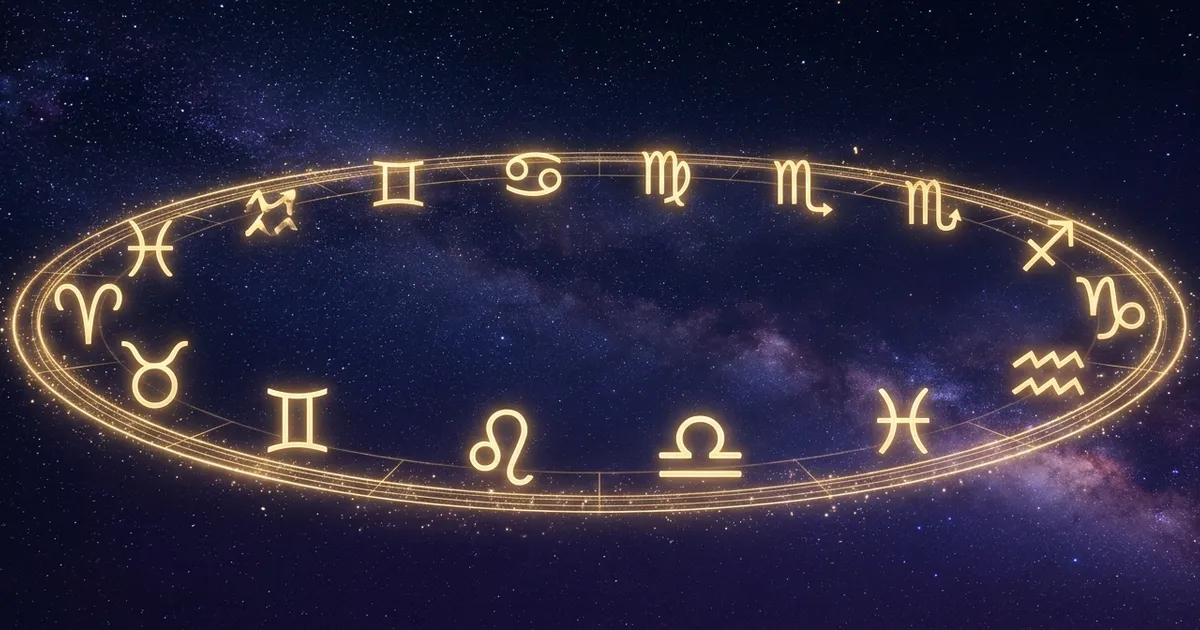
What are the 12 zodiac signs and what do they mean?
The 12 zodiac signs are Aries, Taurus, Gemini, Cancer, Leo, Virgo, Libra, Scorpio, Sagittarius, Capricorn, Aquarius, and Pisces. Each is defined by one element (fire, earth, air, water) and one modality (cardinal, fixed, mutable), forming a framework many people use as a lens for self-reflection rather than prediction.
The word zodiac comes from a Greek phrase meaning "circle of animals," and the signs map a 360° band of sky divided into twelve equal 30° segments. This division is ancient: Babylonian astronomers split the ecliptic into twelve equal signs of 30° each around the end of the fifth century BC, by analogy to twelve schematic months of thirty days (Wikipedia, "Zodiac"). In Western tropical astrology, this band is anchored to the seasons rather than to the visible constellations: the wheel begins at the spring equinox — the First Point of Aries — the moment the Sun crosses into Aries. Your sun sign — the popular "star sign" — simply names which of those twelve segments the Sun was passing through on the day you were born. If you would rather not eyeball a cusp date, you can calculate your natal chart for free to see the Sun's exact position. It is the most famous layer of astrology, but as you will see, it is only the opening note of a much fuller chord.
How are the zodiac signs organized by element and modality?
The twelve signs are not a random list. They are organized by two interlocking systems — four elements and three modalities — that together explain why each sign feels distinct. Four elements multiplied by three modalities produce exactly twelve unique combinations, and no two signs ever share the same pairing. This is the classical triplicity-and-quadruplicity scheme: each element groups three signs of shared temperament, while each modality groups four signs that share a mode of expression — cardinal signs initiate, fixed signs resist change, and mutable signs adapt (Wikipedia, "Astrological sign").
The four elements describe a sign's underlying temperament:
- Fire (Aries, Leo, Sagittarius): spirited, expressive, and action-oriented, drawn to inspiration and momentum.
- Earth (Taurus, Virgo, Capricorn): grounded, practical, and patient, focused on the tangible and the reliable.
- Air (Gemini, Libra, Aquarius): intellectual, social, and communicative, oriented toward ideas and connection.
- Water (Cancer, Scorpio, Pisces): emotional, intuitive, and sensitive, attuned to feeling and depth.
The three modalities (also called qualities) describe how each sign expresses its energy across the seasonal cycle:
- Cardinal (Aries, Cancer, Libra, Capricorn): initiators who start things and set direction. They open each season.
- Fixed (Taurus, Leo, Scorpio, Aquarius): stabilizers who sustain, deepen, and persist. They sit at each season's peak.
- Mutable (Gemini, Virgo, Sagittarius, Pisces): adapters who adjust, blend, and prepare for change. They close each season.
Elements and modalities reference table
This grid shows how every sign occupies a single, unrepeated cell — a quick way to read the "DNA" of any star sign at a glance.
| Modality \ Element | Fire | Earth | Air | Water |
|---|---|---|---|---|
| Cardinal | Aries | Capricorn | Libra | Cancer |
| Fixed | Leo | Taurus | Aquarius | Scorpio |
| Mutable | Sagittarius | Virgo | Gemini | Pisces |
Reading the table is intuitive once it clicks. Aries is cardinal fire — the spark that launches. Taurus is fixed earth — steady, enduring ground. Gemini is mutable air — quick, flexible thought. Knowing a sign's element and modality often tells you more about its character than the symbol or the mythology alone.
What does each of the 12 zodiac signs mean?
Below is a concise meaning for each sign, alongside its dates, element, modality, and traditional ruling planet. In astrology, every sign is linked to a planet (or a luminary, the Sun or Moon) that colors its themes — a relationship explored further in the wider study of the planets in astrology. The date ranges below are approximate: because the Sun's entry into a sign shifts by a day or so each year, anyone born near a cusp should confirm with an exact calculation.
| Sign | Dates (approx.) | Element | Modality | Ruling planet | Core theme |
|---|---|---|---|---|---|
| Aries | Mar 21 – Apr 19 | Fire | Cardinal | Mars | Initiative, courage |
| Taurus | Apr 20 – May 20 | Earth | Fixed | Venus | Stability, pleasure |
| Gemini | May 21 – Jun 20 | Air | Mutable | Mercury | Curiosity, exchange |
| Cancer | Jun 21 – Jul 22 | Water | Cardinal | Moon | Care, belonging |
| Leo | Jul 23 – Aug 22 | Fire | Fixed | Sun | Self-expression, warmth |
| Virgo | Aug 23 – Sep 22 | Earth | Mutable | Mercury | Craft, improvement |
| Libra | Sep 23 – Oct 22 | Air | Cardinal | Venus | Balance, relationship |
| Scorpio | Oct 23 – Nov 21 | Water | Fixed | Mars / Pluto | Depth, transformation |
| Sagittarius | Nov 22 – Dec 21 | Fire | Mutable | Jupiter | Meaning, exploration |
| Capricorn | Dec 22 – Jan 19 | Earth | Cardinal | Saturn | Ambition, structure |
| Aquarius | Jan 20 – Feb 18 | Air | Fixed | Saturn / Uranus | Vision, community |
| Pisces | Feb 19 – Mar 20 | Water | Mutable | Jupiter / Neptune | Imagination, compassion |
The fire signs: Aries, Leo, Sagittarius
The fire signs share a forward-leaning energy. Aries, cardinal fire ruled by Mars, is the archetype of beginnings — bold, direct, and quick to act, sometimes before looking. Leo, fixed fire ruled by the Sun, radiates warmth and creative pride, thriving on heartfelt self-expression and loyalty. Sagittarius, mutable fire ruled by Jupiter, is the seeker — restless for meaning, travel, and the bigger picture. As a lens, the fire signs can help you reflect on where you want more spark, honesty, or momentum.
The earth signs: Taurus, Virgo, Capricorn
Earth signs translate energy into something solid. Taurus, fixed earth ruled by Venus, prizes comfort, loyalty, and sensual pleasure, building security at a patient pace. Virgo, mutable earth ruled by Mercury, brings a discerning, service-minded mind that refines and improves. Capricorn, cardinal earth ruled by Saturn, is the long-game strategist — disciplined, responsible, and quietly ambitious. As a lens, the earth signs invite you to consider what you want to build and sustain.
The air signs: Gemini, Libra, Aquarius
Air signs live in the realm of ideas and connection. Gemini, mutable air ruled by Mercury, is curious and communicative, gathering and trading information with playful versatility. Libra, cardinal air ruled by Venus, seeks harmony, fairness, and partnership, weighing every side of a question. Aquarius, fixed air with ties to Saturn and Uranus, is the independent visionary, drawn to community, innovation, and ideals. The air signs may prompt reflection on how you think, relate, and communicate.
The water signs: Cancer, Scorpio, Pisces
Water signs move through feeling and intuition. Cancer, cardinal water ruled by the Moon, is nurturing and protective, deeply tied to home and emotional security. Scorpio, fixed water associated with Mars and Pluto, is intense and transformative, unafraid of depth and the hidden. Pisces, mutable water linked to Jupiter and Neptune, is compassionate and imaginative, gently dissolving the boundaries between self and other. The water signs can be a quiet prompt to honor what you feel.
Why is your sun sign only part of the picture?
It is tempting to treat your star sign as a full personality verdict, but in practice it is just one layer among many. The Sun describes your core vitality and sense of self — yet at the moment you were born, the Moon and every planet also occupied their own signs, and a sign was rising on the eastern horizon. That rising sign (the Ascendant) shapes how you meet the world and how you come across to others, and it is often as recognizable to people as your Sun. The Moon, meanwhile, governs your inner emotional world.
Mapping all of these placements together is the work of a natal chart — a snapshot of the sky for your exact date, time, and place of birth. Comparing two charts to explore the dynamics between people is called synastry, and Astrollo's free compatibility calculator is one way to explore it. This is why two people who share a sun sign can feel remarkably different: their charts diverge across dozens of other points. A sun-sign reading is a perfectly good starting place, but it is only the foreground of a much larger landscape.
It is worth noting one thing the tropical signs are not: a live map of the current sky. Because Western signs are pinned to the seasons rather than to the stars, they have drifted out of alignment with the constellations they were named after — a slow wobble of Earth's axis, precession, carries the equinox westward over a cycle of roughly 26,000 years. That is also why astronomy and astrology count differently: astronomers recognize that the Sun's yearly path crosses thirteen constellations, including Ophiuchus, whereas astrology keeps to a tidy twelve equal signs. As EarthSky puts it, "There are 12 familiar signs of the zodiac, but no Ophiuchus" (EarthSky). A tropical sun sign is a seasonal coordinate, not a claim about which stars are behind the Sun today.
How are these placements actually calculated?
Reliable astrology rests on accurate astronomy. At Astrollo, sign and planetary positions are computed with the Swiss Ephemeris, which is built on NASA's Jet Propulsion Laboratory ephemeris (DE431, and DE441 since 2022) and reproduces that data to a precision of 0.001 arcseconds — one milliarcsecond (Swiss Ephemeris, astro.com). That precision applies strictly to the astronomical calculation of where the planets were — not to any interpretation, forecast, or claim about your life. The interpretations are then drafted with AI assistance and reviewed by astrologers for tone and accuracy.
It is worth being clear-eyed about what this is and is not. Astrology is a tool for self-reflection and entertainment, not a science of prediction. It is not scientifically proven, and nothing in a chart is guaranteed to happen. What the signs offer is a vocabulary — a set of archetypes — that some people find genuinely useful for thinking about their tendencies, relationships, and choices. Treat any insight it sparks as one perspective among several. It can complement, but should never replace, professional advice on your health, your finances, or any major life decision.
How can you start using the zodiac signs today?
Here is a simple, grounded way to put this framework to work:
- Confirm your sun sign using your exact birth date, especially if you were born near a cusp.
- Locate its element and modality in the grid above, and ask whether those qualities — say, "fixed earth" or "mutable air" — resonate with how you tend to operate.
- Find your rising sign and Moon sign, which usually requires your birth time. These two placements often explain the parts of you that a sun sign alone misses.
- Read the signs as questions, not labels. Instead of "I am a Leo, so I am X," try "Where in my life am I expressing — or neglecting — warmth and creative confidence?"
- Build out the full chart when you are ready, layering in the other planets and the twelve houses for a richer, more personal portrait.
Used this way, the twelve signs become a flexible mirror for reflection rather than a fixed verdict. Start with your Sun, stay curious about the rest, and let the chart be a conversation rather than a conclusion.
Sources
- Wikipedia — Zodiac: Babylonian division of the ecliptic into twelve 30° signs (c. late 5th century BC) and the ~26,000-year precession cycle.
- Wikipedia — Astrological sign: the twelve 30° sectors, the First Point of Aries, and the four elements and three modalities.
- EarthSky — Ophiuchus, the 13th constellation of the zodiac: astronomers count thirteen constellations on the ecliptic versus astrology's twelve signs.
- Swiss Ephemeris — astro.com: the ephemeris is based on NASA JPL DE431/DE441 and reproduces it to 0.001 arcseconds.