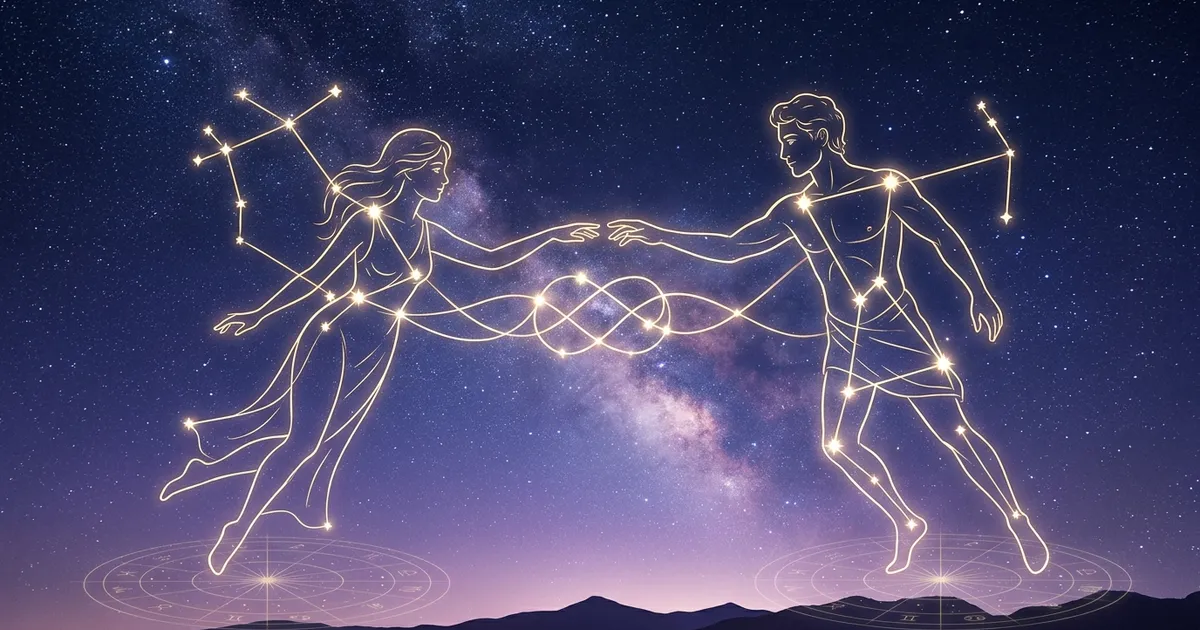
What is synastry in astrology?
Synastry is the branch of astrology that compares two natal charts to explore relationship dynamics. By overlaying one person's planets onto another's, astrologers examine the angles (aspects) and house placements between them, offering a lens to reflect on attraction, communication, and friction — not a guaranteed prediction.
The word comes from the Greek syn ("together") and astron ("star"); Wiktionary traces it to the Ancient Greek synastría — literally a "conjunction of the stars." The practice is sometimes called astrological compatibility or, more loosely, sign compatibility. While popular horoscopes reduce compatibility to Sun signs alone ("a Leo and an Aquarius…"), genuine synastry is far richer. It weighs every major planet, the angles of each chart, and the way the two maps interlock. Sun-sign matching is a fun starting point; synastry is the full conversation.
The idea of comparing charts is ancient. The five core angles used in synastry are the Ptolemaic aspects, named for Claudius Ptolemy, whose 2nd-century-CE Tetrabiblos is described by Wikipedia as having "enjoyed almost the authority of a Bible among the astrological writers of a thousand years or more." That long lineage is history, not proof — it tells us how the vocabulary formed, not how any particular relationship will unfold.
At Astrollo, every chart is computed with the Swiss Ephemeris (DE431 dataset, 0.001° engine precision), and the interpretations are AI-assisted and astrologer-reviewed. That precision applies to the calculation of planetary positions — where Venus or Mars actually sat at a given moment — and not to any claim about how a relationship will turn out. Astrology here is a tool for self-reflection and entertainment, a way to find language for feelings you may already sense.
How does synastry actually work?
Synastry begins with two complete natal charts, each a snapshot of the sky at the moment and place of a person's birth. A natal chart maps the planets in astrology across the twelve zodiac signs and twelve houses, anchored by the rising sign (the Ascendant) on the eastern horizon. To compare two people, an astrologer effectively places one chart inside the other and asks two questions:
- What aspects form between the two sets of planets? An aspect is the angular distance between any two points. When your Venus sits at the same degree as a partner's Mars, that is a conjunction; when they fall roughly opposite, that is an opposition. Each angle carries a different flavour.
- Which houses do the other person's planets land in? A partner's Sun falling in your seventh house of partnership feels different from it falling in your sixth house of daily routine. These "house overlays" colour where the connection is most active.
Read together, these two layers sketch a portrait of how two people may experience one another. The portrait is interpretive — a starting point for conversation, not a verdict.
Which aspects matter most in synastry?
Aspects are the grammar of synastry — if you want a deeper primer on each angle on its own, see our guide to astrological aspects. Some feel harmonious and easy; others feel charged and demanding. Neither is "good" nor "bad" in isolation — easy aspects can drift into comfort, while challenging ones often generate the friction that fuels growth. Here is a reference table of the five major aspects.
| Aspect | Angle | Orb (typical) | General tone | What it may suggest |
|---|---|---|---|---|
| Conjunction | 0° | 8° | Intense, blended | Two energies fuse; can amplify or overwhelm |
| Sextile | 60° | 4° | Supportive, easy | Opportunity, gentle encouragement |
| Square | 90° | 7° | Tense, dynamic | Friction that prompts effort and change |
| Trine | 120° | 8° | Flowing, harmonious | Natural ease, shared rhythm |
| Opposition | 180° | 8° | Polarised, magnetic | Attraction through contrast; a need for balance |
These five are singled out because, as Wikipedia notes, they were the angles "defined and used by Ptolemy" and are the ones divisible evenly into the 360° circle of the ecliptic. The orb is the margin allowed around an exact angle — an aspect within a tight orb is considered stronger than one that is barely in range. When you read a synastry report from Astrollo, you will often see aspects ranked by how exact they are, because a Venus trine Venus at 0.2° of orb tends to speak louder than one stretched to seven degrees. If you would like to see these angles laid out for a single person first, our free natal chart calculator plots every planet and aspect before you ever compare two charts.
Which planets count in relationship astrology?
If aspects are the grammar, the planets are the vocabulary. Each planet governs a different theme, and its role in synastry shifts depending on whether you are exploring romance, friendship, or a working partnership. The table below summarises the principal players.
| Planet | Theme in synastry | What contact may highlight |
|---|---|---|
| Sun | Core identity, vitality | Mutual recognition, feeling "seen" |
| Moon | Emotional needs, comfort | Instinctive care, domestic ease |
| Mercury | Communication, thinking | How smoothly two minds exchange ideas |
| Venus | Affection, values, taste | Romantic warmth, shared pleasures |
| Mars | Drive, desire, assertion | Physical chemistry, and potential clashes |
| Jupiter | Growth, generosity | Encouragement, a sense of expansion |
| Saturn | Structure, duty, time | Seriousness, a feeling of long-term weight |
In romantic synastry, the Venus–Mars dialogue is often the headline: Venus describes how we give and receive affection, Mars how we pursue what we want. Sun and Moon contacts speak to whether two people feel fundamentally at home with each other. Mercury links shape whether everyday conversation flows or stalls. None of these placements decides anything on its own — synastry is always read as a pattern, the way you would read a paragraph rather than a single word.
What do house overlays reveal?
Beyond aspects, synastry asks where one person's planets fall within the other person's twelve houses. This is the layer that most depends on accurate birth times, because the houses rotate quickly — roughly one degree every four minutes. The rising sign sets the entire house framework, so even a small error in birth time can shift an overlay into a different house.
A few illustrative overlays, offered purely as reflective prompts:
- A partner's planets in your 1st house: an immediate sense of recognition; you may feel "activated" in their presence.
- A partner's planets in your 5th house: themes of romance, play, and creativity tend to surface.
- A partner's planets in your 7th house: the classic partnership overlay; the relationship may feel especially significant to you.
- A partner's planets in your 10th house: the connection touches your sense of direction, status, or public life.
These are lenses to consider, not labels to fix on anyone. The same overlay can feel utterly different between two thoughtful adults than between two people who rarely communicate.
Are some elements more compatible than others?
Sun-sign culture leans heavily on the four elements — fire, earth, air, water — and the three modalities (cardinal, fixed, mutable). In real synastry these are background texture rather than the whole picture, but they offer a quick, intuitive read on temperament. The grid below shows the traditional element relationships.
| Fire | Earth | Air | Water | |
|---|---|---|---|---|
| Fire | Energising | Friction | Fanning | Steam |
| Earth | Friction | Grounded | Dust | Nourishing |
| Air | Fanning | Dust | Flowing | Misty |
| Water | Steam | Nourishing | Misty | Deep |
Fire and air are often described as mutually encouraging; earth and water as mutually nourishing. Mixed pairings (fire–water, earth–air) are not doomed — they simply ask for more conscious translation between different styles. Remember that every chart blends all four elements across its planets, so two people are never reducible to a single element. Treat this grid as a conversation-starter about temperament, not a scorecard.
How is synastry different from a composite chart?
These two methods are easily confused. Synastry keeps the two charts separate and studies the interaction between them — your Moon to their Saturn, their Venus to your Ascendant. A composite chart, by contrast, mathematically blends the two charts into a single new chart that represents the relationship itself as a third entity, with its own Sun sign, its own houses, and its own story.
A useful way to hold the distinction: synastry describes how two people relate, while the composite describes the relationship they create together. Many astrologers consult both, treating them as complementary lenses. Astrollo can generate either, computing every position from the same precise ephemeris so the two views stay internally consistent.
What synastry can and cannot tell you
It is worth being honest about the limits, because this is where astrology is most often misused. Synastry may help you notice patterns — where attraction concentrates, where communication snags, where two temperaments differ. It can give you language for dynamics you already half-sense, and that language can make a difficult conversation easier to start.
Synastry cannot diagnose, treat, or predict health, mental health, finances, legal matters, marriage, or separation. No chart can guarantee that a relationship will last or fail. Astrology is not a substitute for honest dialogue, and where real difficulties arise it should complement — never replace — professional advice from qualified people. Held this way, as a reflective tool rather than a fortune-telling device, synastry stays both interesting and responsible.
How to apply synastry: your next step
If you would like to explore your own charts, here is a simple, grounded approach:
- Gather accurate data. For each person, collect the date, exact time, and city of birth. The time matters most for the rising sign and house overlays — guesswork here weakens the reading.
- Start with the big-three contacts. Look first at Sun, Moon, and Ascendant connections between the charts; these describe the foundational feel of the bond before you dive into detail.
- Add Venus and Mars. For a romantic connection, study how these two planets aspect each other across the charts to reflect on affection and chemistry.
- Notice the overlays. See which of your houses light up with a partner's planets, and ask what that area of life means to you.
- Hold it lightly. Use what resonates as a prompt for conversation. Set aside what does not. Synastry is a mirror, not a manual.
When you are ready, you can generate a complete, side-by-side compatibility comparison in minutes — every planet, aspect, and overlay calculated from the Swiss Ephemeris and interpreted in plain language. Approach it with curiosity, and let it open conversations rather than close them.
Sources
- "Synastry," Wiktionary — etymology from Ancient Greek synastría, "conjunction of the stars."
- "Astrological aspect," Wikipedia — the five Ptolemaic aspects, their degrees, and orbs.
- "Tetrabiblos," Wikipedia — Ptolemy's 2nd-century-CE foundational text on planetary aspects.