What Is an Astrological Aspect?
An astrological aspect is the angular distance between two planets in a birth chart, measured in degrees on the 360-degree zodiac. The five major aspects, conjunction, sextile, square, trine and opposition, describe how two planetary energies interact, sometimes harmoniously and sometimes with tension, offering a lens for self-reflection rather than fixed prediction.
The measurement itself is astronomical, not mystical. As Wikipedia's entry on the astrological aspect puts it, aspects "are measured by the angular distance in degrees and minutes of ecliptic longitude between two points." Ecliptic longitude is simply position along the ecliptic, the yearly path the Sun traces on the celestial sphere as a result of Earth's orbit; it runs, per Wikipedia's article on the ecliptic, "positively eastward 0° to 360° along the ecliptic from the March equinox." Every aspect in your chart is just the gap between two of those longitudes.
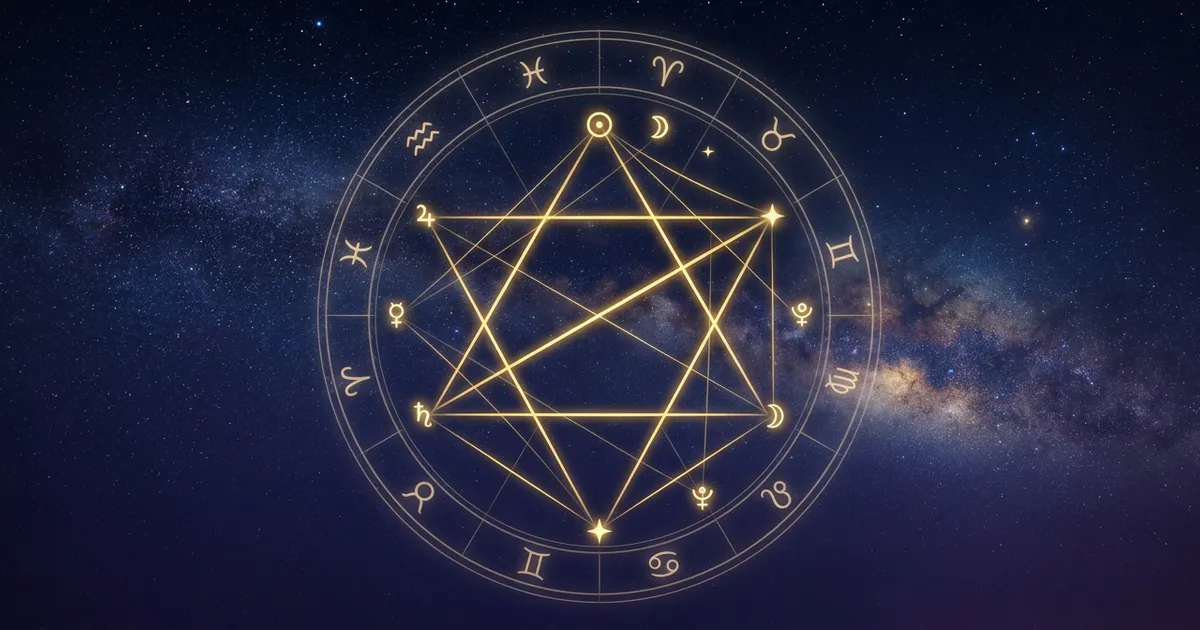
In other words, astrological aspects are the lines drawn between planets, the wiring that turns a scatter of symbols into a connected story. A planet on its own says one thing; the same planet locked into a tight square with another says something richer. Aspects describe relationships inside the psyche: which drives reinforce each other, which create friction, and which barely speak. Because the angles are precise geometry, modern calculation engines such as Swiss Ephemeris can pin them to a fraction of a degree, but the meaning you draw out remains a reflective tool, never a deterministic forecast of your life. If you want to see these angles in your own chart, you can generate a free natal chart and read them alongside the planets that form them.
The Five Major Aspects at a Glance
The five major aspects are the foundation of chart reading. They are old: astrologers often call them the Ptolemaic aspects, and as The Astrology Podcast notes, "The five major aspects, also sometimes known as the Ptolemaic aspects, are the conjunction, opposition, trine, square, and sextile," named for the second-century astronomer Claudius Ptolemy who codified them. Each corresponds to a clean division of the 360-degree circle, and each carries a recognisable "feel". Conjunctions merge two energies; sextiles open opportunity; squares create friction; trines let energy flow; oppositions bring awareness through polarity. Learning these five is the single most useful step after learning the planets themselves, because they repeat everywhere you look.
| Aspect (glyph) | Exact angle | Nature | Typical orb | Keyword / feel |
|---|---|---|---|---|
| Conjunction ☌ | 0° | Neutral / intensifying | 8° | Merger, fusion |
| Sextile ⚹ | 60° | Harmonious | 4–6° | Opportunity |
| Square □ | 90° | Tense | 6–8° | Friction, drive |
| Trine △ | 120° | Harmonious | 6–8° | Flow, ease |
| Opposition ☍ | 180° | Tense | 6–8° | Awareness, polarity |
A quick way to remember the geometry: the circle divided by 1 gives the conjunction, by 2 the opposition, by 3 the trine, by 4 the square, and by 6 the sextile. The cleaner the division, the more major the aspect. This is why these five carry the most weight in any chart reading, while finer subdivisions produce the subtler minor aspects covered further below.
Notice also how the natures pair up by geometry. The trine and sextile both come from dividing the circle into harmonious thirds and sixths, and both feel cooperative. The square and opposition come from halving and quartering the circle, and both introduce productive tension. The conjunction stands apart as a pure blending of two planets sitting in the same place. Once you internalise this logic you can often guess an aspect's flavour from its angle alone, long before you memorise every pairing.
Harmonious vs. Tense: Why No Aspect Is "Good" or "Bad"
It is tempting to sort aspects into "lucky" trines and "difficult" squares, but experienced readers resist that shortcut. Harmonious aspects (trines and sextiles) describe energy that flows freely. They feel like natural talent, things that come so easily you may not even notice them. Tense aspects (squares and oppositions) describe friction, where two drives grind against each other and demand resolution.
Here is the catch: ease can breed complacency, while friction tends to build character. Many of the most accomplished, self-aware people carry prominent squares, because the tension forced them to develop. Consider the contrast:
- Trines and sextiles give gifts that, left unused, can lie dormant.
- Squares and oppositions give challenges that, when worked with, become strengths.
- The conjunction is genuinely neutral, taking on the character of the planets involved.
This split has a formal name in the tradition. In the classification described by Wikipedia's astrological aspect entry, the conjunction, square and opposition are treated as "hard" aspects while the sextile and trine are "soft" aspects, with hard aspects generally read as more potent and more challenging. The same tension-versus-flow logic reappears when two charts are compared side by side, which is why it underpins compatibility and synastry as well.
Read aspects as different kinds of energy to work with, not as verdicts. Astrology here is a mirror for growth, not a ranking of fortunate and unfortunate fates.
Understanding Orbs: How Close Counts
An aspect is rarely exact to the degree, so astrologers allow a margin called an orb, the number of degrees by which two planets may stray from the perfect angle and still "count". The smaller the orb, the stronger and more pointed the aspect feels; the wider the orb, the more diffuse and background it becomes.
There is no single universal orb table, but common practice looks like this:
- Major aspects: 6–8° for the trine, square and opposition.
- Conjunction: up to 8°, sometimes more when the Sun or Moon is involved.
- Sextile: a tighter 4–6°.
- Minor aspects: narrow, often 1–3°.
The Sun and Moon usually earn slightly wider orbs because of their visual and symbolic weight. A Sun square Saturn within 1° is a defining feature of a chart; the same square at 7° still operates, but quietly. When you read your own astrological aspects, always note the orb, because it is the single best clue to how loudly an aspect speaks.
Applying vs. Separating Aspects
Two planets forming the same aspect can feel different depending on direction of movement. An applying aspect is one where the faster-moving planet is heading toward exactness, the angle tightening over the hours and days after birth. A separating aspect is one where the faster planet has already passed exactness and the angle is widening.
The traditional reading is that applying aspects are more potent and forward-pressing, because the energy is "building", while separating aspects describe something already integrated, more in the past tense. In practice:
- Applying: active, intensifying, often felt as a live theme you are still working out.
- Separating: settled, woven in, sometimes experienced as a given you take for granted.
To tell them apart you need accurate birth data and a precise ephemeris, since the distinction can hinge on degrees and minutes. It is a refinement rather than a beginner's first concern, but it adds real nuance once the five majors feel familiar.
Minor Aspects and When They Matter
Beyond the five majors lie the minor aspects, subtler angles that fine-tune a reading. They are real but quieter, and most astrologers only count them with tight orbs of one to three degrees so the chart does not drown in lines.
| Minor aspect | Angle | Feel |
|---|---|---|
| Semisextile | 30° | Mild adjustment, subtle link |
| Semisquare | 45° | Low-grade friction, irritation |
| Sesquiquadrate | 135° | Persistent inner tension |
| Quincunx (inconjunct) | 150° | Mismatch, ongoing recalibration |
The quincunx is the most discussed minor aspect, connecting two planets that share neither element nor modality, so they struggle to relate, like roommates who keep adjusting to each other. Minor aspects rarely define a chart on their own, but when one falls within a degree of exactness, especially touching a personal planet, it can colour a theme in a way the majors miss. Treat them as seasoning, not the main dish.
Aspect Patterns: How Aspects Weave the Whole Chart Together
Individual aspects are powerful, but several aspects together can form recognisable aspect patterns, geometric figures that link three or more planets into a single, self-reinforcing dynamic. Spotting a pattern tells you where a chart concentrates its energy.
| Pattern | Components | Meaning |
|---|---|---|
| Grand Trine | Three planets in trine (a triangle) | Flowing talent in one element |
| T-Square | Two planets opposed, both square a third | Driving tension with a focal point |
| Grand Cross | Four planets in two oppositions, all squared | High-pressure, high-output dynamism |
| Yod | Two planets sextile, both quincunx a third | A "finger of fate", a focused calling |
A Grand Trine in fire signs, for example, suggests easy creative confidence, while a T-Square points to a planet (the apex) where pressure builds and decisive action is demanded. Patterns are where the chart stops being a list of pairs and becomes a living system. Reading them is how you see the birth chart as a whole rather than a collection of parts.
How to Read the Aspects in Your Own Chart (step-by-step)
You do not need to be an expert to start reading your own astrological aspects. Work through it patiently, one connection at a time.
- Generate an accurate chart. Use your exact date, time and place of birth so the angles are precise.
- Find the aspect grid. Most charts include a grid (or "aspectarian") listing every aspect between planets.
- Start with the tightest aspects. Sort by orb and read the closest first, since these speak loudest.
- Prioritise personal planets. Aspects to the Sun, Moon, Mercury, Venus and Mars feel more personal than outer-planet pairs.
- Name the two energies, then the angle. "My Venus trines my Jupiter" becomes "ease and warmth in how I value and grow".
- Look for patterns. Check whether your aspects cluster into a T-Square, Grand Trine or Yod.
Hold every interpretation lightly. Astrology is a tool for self-reflection and insight, not a substitute for medical, financial, legal or psychological advice. Use your chart as one mirror among many, and keep your own judgement at the centre.
Ready to see how your planets connect? Calculate your free natal chart with Astrollo and explore your own astrological aspects, the angles that weave your whole chart into a single story.
Sources
- Astrological aspect — Wikipedia: definition of aspects as angular distance in ecliptic longitude, the five major (Ptolemaic) aspects, orbs, and the hard/soft classification.
- Ecliptic — Wikipedia: the ecliptic as the Sun's yearly apparent path and ecliptic longitude measured 0°–360° eastward from the March equinox.
- Aspects in Astrology: The Five Major Configurations — The Astrology Podcast: the five major aspects as the "Ptolemaic aspects."