What are the planets in astrology and what do they mean?
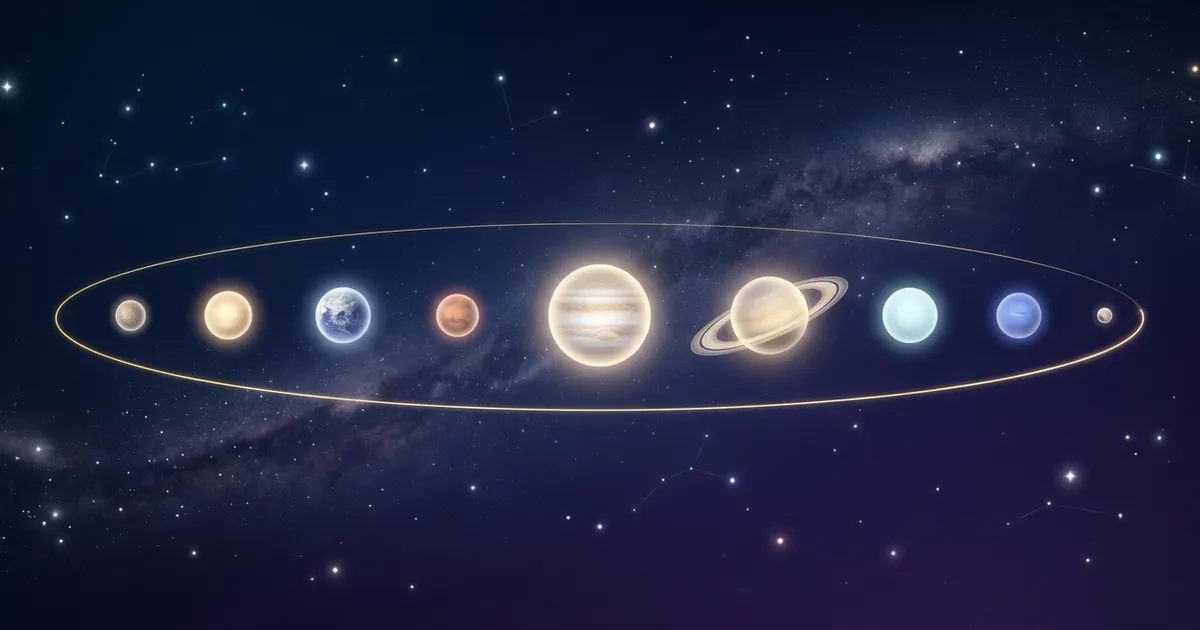
In astrology, the planets are the ten moving symbolic forces of a birth chart, and each one governs a part of human experience. They divide into three families: personal planets (Sun, Moon, Mercury, Venus, Mars) that shape your identity and daily drives; social planets (Jupiter, Saturn) that frame growth and responsibility; and transpersonal planets (Uranus, Neptune, Pluto) that mark slow, generational themes.
Where the zodiac signs describe how an energy expresses itself and the houses describe where in life it plays out, the planets describe what the energy actually is. A planet is the verb of the chart — the active principle. Understanding the planets is therefore the foundation for reading any natal chart, comparing two charts in synastry, or making sense of your rising sign. This pillar guide walks through all ten, group by group, as a lens for self-reflection rather than a tool for prediction.
Why are there ten "planets" when astronomy counts differently?
Astrology and astronomy describe the sky differently because they ask different questions. Astronomy classifies bodies by their physical nature; astrology classifies them by their symbolic role as seen from Earth. That is why two of the ten are not planets at all in the strict astronomical sense.
The Sun is a star and the Moon is Earth's satellite. In astrology both are called the luminaries and are counted among the "planets" because they are interpretive points that an observer on Earth experiences as moving lights. Pluto, meanwhile, was reclassified as a dwarf planet in 2006 by the International Astronomical Union — because it has not cleared other objects from its orbital path in the Trans-Neptunian region — yet astrologers kept it because its symbolic meaning was already woven deeply into chart interpretation. Two of the outer planets are historically recent additions as well: Uranus, discovered by William Herschel in 1781, was the first planet found with the aid of a telescope, since Mercury through Saturn are all bright enough to see with the naked eye. So when astrologers say "the planets," they mean the ten classical chart factors, not a literal astronomical list.
Behind the symbolism sits real computation. The positions Astrollo reports are calculated with the Swiss Ephemeris, which since 2014 is based on NASA JPL's DE431 data and reproduces that data to within 0.001 arcseconds (one milliarcsecond) for the bodies themselves. That precision describes only the math of planetary positions — it is never a claim that any interpretation is guaranteed or scientifically proven. Astrology is best treated as a reflective and entertaining lens, not a forecast of real-world outcomes.
How are the planets grouped — personal, social, and transpersonal?
The clearest way to learn the planets is by speed. Faster-moving bodies feel personal because they change sign often, so they describe what makes you different from a sibling born nearby. Slower bodies feel collective because they sit in one sign for years, so whole peer groups share them.
| Group | Planets | Approx. speed | What it describes |
|---|---|---|---|
| Personal (inner) | Sun, Moon, Mercury, Venus, Mars | Days to ~2 years per sign | Identity, emotion, mind, love, drive |
| Social | Jupiter, Saturn | ~1–2.5 years per sign | Growth, opportunity, structure, maturity |
| Transpersonal (outer) | Uranus, Neptune, Pluto | ~7–20+ years per sign | Generational change, ideals, deep transformation |
This grouping also explains why your Sun-sign horoscope feels personal while outer-planet themes feel like the mood of an era. The personal planets are the heart of self-understanding; the outer planets are the backdrop you share with millions of contemporaries.
What do the personal planets mean?
The five personal planets form the core of your individual personality. They move quickly through the zodiac signs, so their placements are highly specific to you and your exact moment of birth.
The Sun — core identity and vitality
The Sun represents your essential self, conscious purpose, and the qualities you are growing into. It is the "I am" of the chart and the single most-referenced point, which is why "what's your sign?" really means "where is your Sun?" In the natal chart, the Sun's sign and house suggest where you may shine, feel most alive, and seek recognition — a place to reflect on what genuinely energizes you.
The Moon — emotions and inner needs
The Moon governs your emotional world, instincts, and what makes you feel safe. It changes sign roughly every two and a half days, so it is intensely personal. Reading the Moon is a gentle way to consider your habits, comfort needs, and how you self-soothe — useful for self-reflection, though never a substitute for professional support with genuine emotional or mental-health concerns.
Mercury — mind and communication
Mercury rules thinking, learning, speech, and how you process information. Its placement hints at your natural communication style — quick and verbal, careful and analytical, or somewhere in between. Because Mercury never strays far from the Sun, it always sits in the same sign as your Sun or one beside it.
Venus — love, values, and attraction
Venus describes what you find beautiful, how you give and receive affection, and what you value in relationships and aesthetics. It is a key planet in synastry, the art of comparing two charts, because shared or harmonious Venus placements can describe relationship chemistry as a topic for reflection rather than a verdict on any particular partnership. If you want to see how two people's Venus placements interact, you can run a free compatibility reading and read it alongside this guide.
Mars — drive, energy, and assertion
Mars is your engine: ambition, courage, desire, and how you pursue what you want. Its sign reflects your characteristic way of taking action and handling friction. A well-understood Mars can help you reflect on how you channel energy and assert boundaries.
What do the social planets mean?
Between the swift inner planets and the slow outer ones sit Jupiter and Saturn, the social or "bridge" planets. They move slowly enough to shade a couple of birth years, yet personally enough to matter in your individual chart. Together they describe the rhythm of growth and limits across your life.
Jupiter — expansion and opportunity
Jupiter is the planet of growth, optimism, learning, and good fortune as a frame of mind. Its placement suggests where you naturally seek meaning, take risks, and feel generous or lucky. Read it as an invitation to explore possibility — a confidence cue rather than a promise of material reward.
Saturn — structure, discipline, and maturity
Saturn governs responsibility, boundaries, time, and earned mastery. It is the planet of "the long game," showing where life may ask for patience and where consistent effort can build something lasting. The well-known Saturn return, around ages 28–30, is widely used as a prompt for reflecting on maturity and commitments — a symbolic milestone rather than a predicted event.
What do the transpersonal planets mean?
The three outermost planets — Uranus, Neptune, and Pluto — move so slowly that they stay in one sign for years. As a result they describe themes shared by an entire generation more than your private personality. In your chart, their house placement and the aspects they make to your personal planets are what bring their generational current down to a personal level.
Uranus — change, freedom, and innovation
Uranus symbolizes sudden insight, independence, rebellion against convention, and the urge to innovate. Where it sits in your chart can describe the area of life where you most value freedom and originality, and where you may feel drawn to break from routine.
Neptune — imagination, dreams, and spirituality
Neptune rules imagination, intuition, compassion, art, and the longing for something transcendent. Its gifts are inspiration and empathy; its shadow is illusion and escapism — a reminder to pair vision with grounded reality rather than treat dreams as certainties.
Pluto — transformation and depth
Pluto represents deep change, power, and the cycles of release and renewal. It points to where you may experience profound personal evolution over long stretches of time. Treat it as a symbol of growth-through-letting-go, not as a forecast of any specific loss or crisis.
Which planets rule which zodiac signs?
Each zodiac sign has a traditional planetary ruler — the planet most "at home" in that sign. Rulership is a core concept for reading a chart, because the ruler of your rising sign (the "chart ruler") often takes on extra importance. The table below pairs each sign with its modern ruler.
| Zodiac sign | Modern ruling planet | Core theme of the ruler |
|---|---|---|
| Aries | Mars | Drive and initiative |
| Taurus | Venus | Values and pleasure |
| Gemini | Mercury | Communication |
| Cancer | Moon | Emotion and care |
| Leo | Sun | Identity and vitality |
| Virgo | Mercury | Analysis and skill |
| Libra | Venus | Harmony and relating |
| Scorpio | Pluto | Depth and transformation |
| Sagittarius | Jupiter | Growth and meaning |
| Capricorn | Saturn | Structure and ambition |
| Aquarius | Uranus | Innovation and freedom |
| Pisces | Neptune | Imagination and compassion |
Traditional astrology used a shorter list of rulers before the outer planets were discovered (for example, Mars also ruled Scorpio, and Saturn also ruled Aquarius). Many astrologers still honor those classical rulerships alongside the modern ones, so you may see both referenced when you read about a sign.
How do the planets work together in a natal chart?
A single planet is only one word; the natal chart is the sentence. Three layers combine to create meaning, and learning to hold all three at once is the real skill of chart reading.
- The planet is what the energy is (e.g., Venus = love and values).
- The sign is how that energy expresses (e.g., Venus in Aries = direct, bold affection).
- The house is where it plays out in life (e.g., Venus in the 7th house = partnership).
On top of that, aspects — the geometric angles between planets — describe how the planets cooperate or create tension within you. The Sun, Moon, and rising sign are usually read first as the Big Three, giving a fast yet meaningful snapshot before deeper analysis. When comparing two people in synastry, astrologers look at how one person's planets land in the other's chart to reflect on relationship dynamics.
All of this is a structured way to think about yourself and your connections — a lens for self-reflection and entertainment. It complements, and never replaces, professional guidance for health, mental wellbeing, finances, or major life decisions.
How can I apply this — what's the next step?
Start small and personal, then widen out. A practical path:
- Find your Big Three first. Identify your Sun, Moon, and rising sign, and read each as a standalone theme. This gives you the strongest foothold.
- Add the rest of the personal planets. Note your Mercury, Venus, and Mars by sign to flesh out mind, love, and drive.
- Layer in the social and outer planets. See where Jupiter and Saturn sit, then notice which house holds your Uranus, Neptune, and Pluto.
- Read planet + sign + house together. Resist judging a single placement in isolation; the whole chart provides context.
- Treat insights as questions, not verdicts. Use each placement as a prompt for reflection rather than a fixed prediction.
To do this accurately you need your exact birth date, time, and location, since the Moon and rising sign change quickly. Astrollo calculates your planetary positions with the Swiss Ephemeris (DE431) and pairs them with AI-assisted, astrologer-reviewed interpretations, so you can explore every placement clearly and at your own pace. When you are ready, build your free natal chart to see every planet's sign and house in one place.
Sources
- NASA Science — Pluto: Facts — Pluto's 2006 reclassification as a dwarf planet by the International Astronomical Union.
- Science Museum (London) — Uranus: the first planet discovered with a telescope — William Herschel's 1781 discovery of Uranus.
- Astrodienst — Swiss Ephemeris — precision to 0.001 arcseconds relative to NASA JPL's DE431 ephemeris.