Lunar Calendar 2027: Moon Phases, New & Full Moons, and Eclipses
Thirteen new moons, twelve full moons, and five eclipses — a full year of lunar rhythm, mapped and explained.
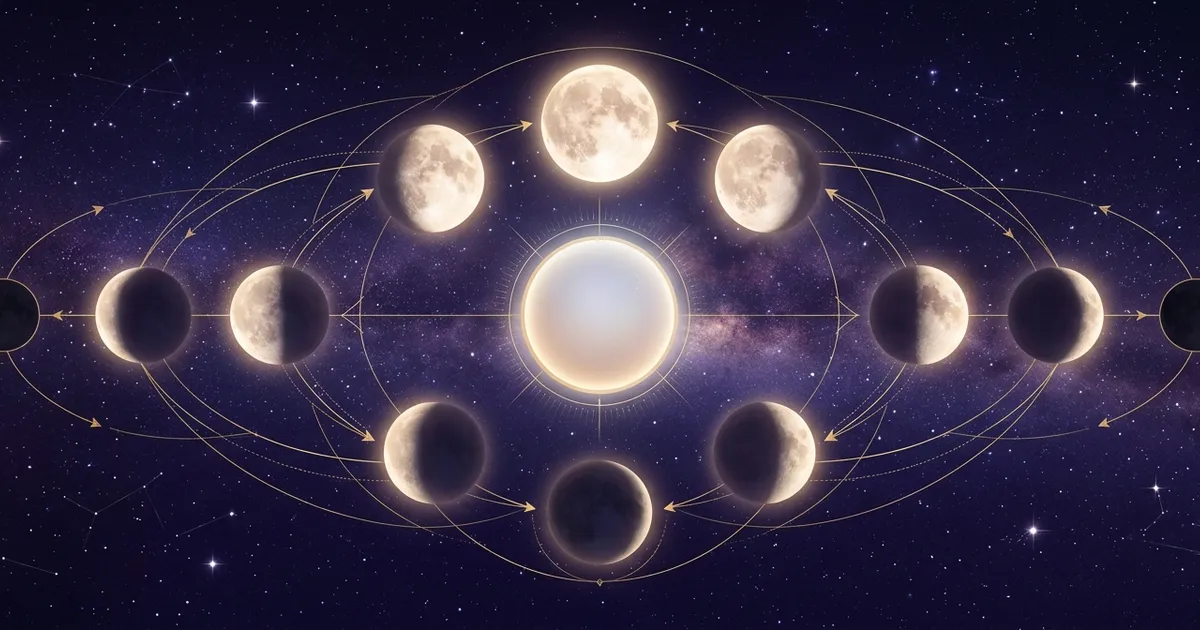
In 2027 the Moon runs through thirteen new moons and twelve full moons, marked out by five eclipses. The standout event is the total solar eclipse of August 2 in Leo — nicknamed the "Eclipse of the Century" because it is the longest total solar eclipse of the 21st century, with up to about six minutes and twenty-three seconds of totality along a path that sweeps from southern Spain across North Africa to the Arabian Peninsula.
The year opens with the first new moon on January 7 in Capricorn and includes a rare double: two new moons in August (August 1, and again in Virgo on August 31), which is why some months feel like they hold two fresh starts. The exact date and sign of every lunation appear in the table further down the page.
A lunar calendar is a tool for rhythm, not prophecy. People use it to time reflection, set intentions at the new moon, and take stock at the full moon. Read it as a way to notice your own cycles — not as a forecast of fixed events.
The Eight Phases of the Moon
The Moon moves through a repeating cycle of about 29.5 days, from dark to full and back again. Astronomers and astrologers usually divide that cycle into eight phases. Four of them are the milestones most people track — new, first quarter, full, and last quarter — while the four in between mark the Moon growing brighter (waxing) or fading (waning). Knowing where the Moon sits in this cycle is the simplest way to use a lunar calendar day to day.
New Moon
At the new moon the Moon sits between Earth and the Sun and is effectively invisible — the sky is dark, and many people treat it as a natural moment to pause, reset, and set intentions.
Waxing Moon
As the Moon waxes from a crescent through the first quarter to a gibbous, its lit face grows night by night; this rising-light stretch is often used as a cue to build, act on plans, and keep up momentum.
Full Moon
The full moon rises opposite the Sun as a complete, bright disc — the brightest, most visible point of the cycle, and traditionally a time to notice what has come to a head and to take stock.
Waning Moon
After the full moon the light fades through the waning gibbous, last quarter, and waning crescent back to dark — a winding-down stretch many treat as time to release, rest, and clear space before the next new moon.
The 13 New Moons of 2027
2027 holds thirteen new moons — one more than the usual twelve — beginning with the new moon in Capricorn on January 7. That extra lunation comes from August, which carries two new moons: one on August 1 and a second in Virgo on August 31. Each new moon is the darkest point of its cycle and, for many, the quietest — a nudge to slow down and start something fresh rather than push. Two of the year's new moons coincide with solar eclipses (February 6 in Aquarius and August 2 in Leo), which lend those resets extra weight. The complete list of dates and zodiac signs is in the table below.
The 12 Full Moons of 2027
The year brings twelve full moons, roughly one a month, each marking the peak of its lunar cycle, when the Moon is fully lit and most visible in the night sky. Full moons are the bright, culminating counterpart to the quiet of the new moon — a natural checkpoint to notice what has ripened and what you're ready to let go of. Three of 2027's full moons align with penumbral lunar eclipses (February 20 in Virgo, July 18 in Capricorn, and August 17 in Aquarius), when the Moon passes through Earth's faint outer shadow and dims subtly rather than turning red. Exact dates and signs appear in the table on this page.
The 5 Eclipses of 2027
2027 delivers five eclipses — two solar and three lunar — and one of them is genuinely historic. The year opens with an annular solar eclipse on February 6 in Aquarius, a \"ring of fire\" visible from parts of South America including Chile and Argentina. Two weeks later, on February 20, a penumbral lunar eclipse in Virgo becomes the most noticeable of the year's three lunar events, with the Moon sliding roughly 93% into Earth's outer shadow. A very faint penumbral lunar eclipse in Capricorn follows on July 18. Then comes the centerpiece: the total solar eclipse of August 2 in Leo, the longest total solar eclipse of the 21st century — up to about 6 minutes 23 seconds of totality near Luxor — with a path crossing southern Spain, Gibraltar, Morocco, Algeria, Tunisia, Libya, Egypt, Saudi Arabia, Yemen and Somalia, over roughly 89 million people. The eclipse season closes on August 17 with another faint penumbral lunar eclipse in Aquarius. Astrologically, eclipses are often read as accelerated new and full moons; the Leo eclipse is felt most keenly by Leo, while the Aquarius eclipses resonate with Aquarius amid Pluto's long stay in that sign. Treat these as prompts for reflection, not as predictions of specific events.
Annular solar eclipse in Aquarius
Visible from South America (Chile, Argentina)
Penumbral lunar eclipse in Virgo
Americas, Europe, Africa
Penumbral lunar eclipse in Capricorn
Very faint (penumbral)
Total solar eclipse in Leo
Southern Spain, North Africa, Middle East
Penumbral lunar eclipse in Aquarius
Very faint (penumbral)
How to Use the 2027 Lunar Calendar
A simple, honest way to work with the Moon's rhythm across the year without treating it as prediction.
- 1
Find the current phase
Check the table on this page to see whether the Moon is new, waxing, full, or waning right now, and which zodiac sign it's in.
- 2
Use new moons to begin
Around each new moon — starting January 7 — take a quiet moment to reflect and set an intention for the weeks ahead.
- 3
Use full moons to take stock
At each full moon, notice what has come to a head since the new moon and what you're ready to release.
- 4
Watch the eclipse dates
Note the five eclipses, especially the August 2 total solar eclipse in Leo, and treat them as amplified moments for reflection rather than forecasts of events.
Frequently Asked Questions
How many new and full moons are there in 2027?
2027 has 13 new moons and 12 full moons. The extra new moon comes from August, which has two — on August 1 and again in Virgo on August 31. The first new moon of the year falls on January 7 in Capricorn.
When is the total solar eclipse in 2027?
The total solar eclipse falls on August 2, 2027, in the sign of Leo. It is the longest total solar eclipse of the 21st century, with up to roughly 6 minutes 23 seconds of totality, and its path crosses southern Spain, North Africa and the Arabian Peninsula.
How many eclipses happen in 2027?
There are five eclipses in 2027: an annular solar eclipse on February 6 (Aquarius), a total solar eclipse on August 2 (Leo), and three penumbral lunar eclipses on February 20 (Virgo), July 18 (Capricorn) and August 17 (Aquarius).
What is a penumbral lunar eclipse?
A penumbral lunar eclipse happens when the full Moon passes through Earth's faint outer shadow, the penumbra. Instead of turning red like a total lunar eclipse, the Moon only dims slightly — subtle enough that all three of 2027's lunar eclipses are hard to spot with the naked eye, though February 20 is the most prominent.
What do the Moon phases mean in astrology?
In astrology the new moon is read as a time for fresh starts and intentions, the waxing phase as building momentum, the full moon as culmination and awareness, and the waning phase as release and rest. These are frameworks for self-reflection and entertainment — a way to notice your own cycles, not predictions of fixed outcomes.
Does the 2027 lunar calendar predict my future?
No. A lunar calendar shows the astronomical rhythm of the Moon and how astrology traditionally interprets it. It's a tool for reflection and for timing your own intentions, not a forecast of events. Use it to understand yourself better, and make your own decisions.
Read your own chart against the 2027 sky
The Moon's rhythm lands differently depending on your birth chart. Get a free AI-assisted natal reading from Astrollo and see how the 2027 new moons, full moons and eclipses connect to your own placements.
Get my free birth chartExplore More of 2027
Astrology is offered here for self-reflection and entertainment. It is not a science and does not predict fixed events, nor does it provide medical, financial, legal or psychological advice. Astronomical data (eclipse and lunation dates) is based on standard ephemeris calculations, while astrological interpretations are traditional frameworks — not statements of fact. Always use your own judgment and consult a qualified professional for important decisions.