What Are the Lunar Nodes? The North-South Axis Explained
The lunar nodes are two opposite calculated points, not physical bodies, where the Moon's orbit crosses the ecliptic. Together they form a karmic growth axis: the South Node marks familiar, inherited patterns that feel like a comfort zone, while the North Node points toward a growth direction your chart invites you to develop. Astrologers read them as a reflective lens, never as fate.
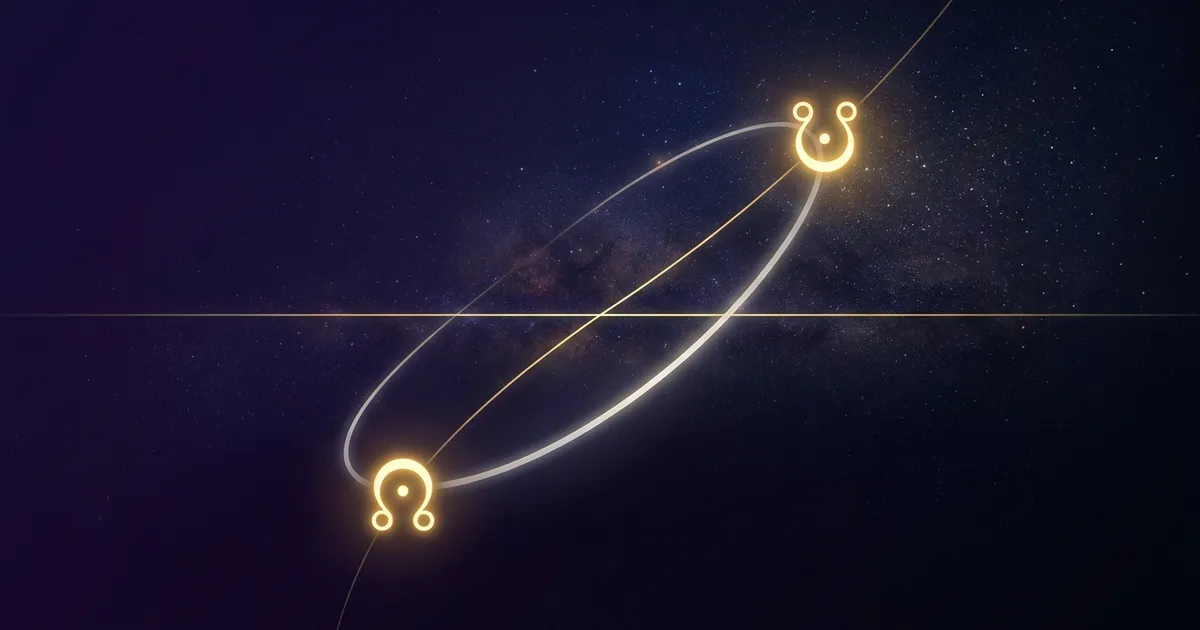
Because the lunar nodes are mathematical intersections rather than visible objects, they carry no physical light of their own. What they offer is symbolic geometry. The Moon's orbit is tilted at a mean angle of 5.145° to the plane of Earth's orbit around the Sun, and according to NASA's eclipse reference that tilt produces exactly two crossing points on the ecliptic. Astronomers call the point where the Moon climbs into the northern ecliptic hemisphere the ascending node, and the one where it drops south the descending node, as Wikipedia's entry on the lunar node sets out. Astrology treats that crossing as a meaningful tension between where you have been and where you are growing. This is why the nodes feel less like a "trait" and more like a story about movement and direction over a lifetime. If you want to see exactly where yours land, a free natal chart plots both nodes to the degree.
South Node: Inherited Patterns and the Familiar Comfort Zone
The South Node represents the default settings of your chart, the responses you reach for automatically when life gets demanding. In karmic astrology it is often described as gifts and patterns carried from the past, but you can read it just as usefully as deeply ingrained habits, family conditioning, or skills so practised they feel like instinct.
The trap of the South Node is over-reliance. These behaviours are comfortable precisely because they are well rehearsed, so they can quietly become a place to hide rather than a base to launch from. Reflecting on your South Node sign and house can reveal:
- The role you slip into under stress without thinking.
- Talents you may take for granted because they come too easily.
- A familiar identity that feels safe but can keep you stuck.
The aim is not to reject these strengths. It is to notice when you are leaning on them defensively instead of using them as a foundation for genuine growth.
North Node: Your Growth Direction and Soul Assignment
The North Node points the opposite way, toward qualities that feel unfamiliar, slightly awkward, and worth developing. Where the South Node is your comfort zone, the North Node is your stretch zone. It often describes the very things you avoid or admire in others, the lessons that bring the most meaning when you finally lean into them.
Growth at the North Node rarely feels natural at first. By definition it asks you to build skills you have not over-practised, which is why it can register as anxiety, resistance, or "that's not really me." Used reflectively, the North Node sign and house can prompt questions like:
- What direction keeps calling me even when it feels uncomfortable?
- Which qualities do I admire in others that I could cultivate myself?
- Where would conscious effort, rather than autopilot, expand my life?
Think of it as an invitation rather than an instruction. The North Node names a direction of growth; how and whether you walk toward it remains entirely your choice.
The Nodal Axis: Why North and South Always Work as a Pair
The North Node and South Node sit exactly 180 degrees apart, so they are never read in isolation. They form a single nodal axis, a continuum running between an over-developed comfort zone and an under-developed growth edge. Whatever sign and house hold one node, the opposite sign and house hold the other.
This pairing is the heart of the symbolism. The work is not to amputate the South Node and chase the North Node, but to rebalance the axis: carry your existing strengths forward while consciously stretching toward the qualities you have neglected. A useful image is a seesaw that has tipped too far one way. The goal is integration, drawing on the familiar pole to support your reach toward the growth pole, so the whole axis becomes more flexible and conscious over time.
Lunar Nodes Through the Twelve Signs: The Six Polarities
Because the lunar nodes are always opposite, the twelve signs reduce to six polarities. Each pairs a familiar pattern (South Node) with a growth invitation (North Node). The keywords below are reflective prompts, not verdicts.
| South Node sign | North Node sign | Familiar pattern (South) | Growth invitation (North) |
|---|---|---|---|
| Aries | Libra | Self-reliant, impulsive, going it alone | Partnership, balance, considering others |
| Taurus | Scorpio | Holding on, comfort, self-sufficiency | Trust, depth, embracing change |
| Gemini | Sagittarius | Scattered facts, restless curiosity | Meaning, big-picture vision, conviction |
| Cancer | Capricorn | Retreating into safety and care-taking | Maturity, structure, owning responsibility |
| Leo | Aquarius | Spotlight, personal recognition | Community, contribution, the bigger group |
| Virgo | Pisces | Overanalysis, control, perfectionism | Trust, compassion, surrender to flow |
Read your own polarity gently. The familiar side is real strength; the growth side is the stretch your chart keeps offering.
Lunar Nodes by House: Where the Growth Plays Out
If the sign describes the flavour of growth, the house shows the life arena where the nodal theme is most visible. The North Node house highlights where to lean in; the opposite South Node house shows where the comfortable default lives.
| House | Life area where the nodal theme shows up |
|---|---|
| 1st / 7th | Self-identity versus relationships and partnership |
| 2nd / 8th | Personal resources versus shared and transformative bonds |
| 3rd / 9th | Everyday learning versus higher meaning and travel |
| 4th / 10th | Home and roots versus career and public role |
| 5th / 11th | Personal expression versus community and collective goals |
| 6th / 12th | Daily routine and service versus rest, retreat and the inner life |
Locating your North Node house can turn an abstract growth theme into something concrete, a specific corner of life where conscious effort tends to pay off.
Rahu and Ketu: The Vedic Lens on the Nodes
In Vedic astrology the same two points carry their own names and rich mythology. The North Node is Rahu and the South Node is Ketu, and they are central figures rather than minor markers. This mapping is not just poetic: Wikipedia's article on Rahu describes it as representing "the ascension of the Moon in its precessional orbit around the Earth, also referred to as the north lunar node," paired with Ketu as the south node. Both are traditionally called chhaya graha or "shadow planets" precisely because, sitting at the intersections that make eclipses possible, they shape desire, fate themes and spiritual growth in the tradition.
Broadly, Rahu mirrors the Western North Node: it points toward worldly experience, hunger for the new, and the unfamiliar territory the soul is here to explore, sometimes to excess. Ketu echoes the South Node: detachment, mastery already attained, and a pull toward letting go. The Vedic framing leans more openly spiritual and karmic than many Western readings, but the underlying axis is the same. Comparing the two traditions can deepen your reflection, showing the lunar nodes as a meeting point of growth and release described by very different cultures.
Nodal Returns, Eclipses, and Reading Your Nodes Over Time
The lunar nodes are always in motion, drifting backward (retrograde) through the zodiac and completing one full cycle in roughly 18.6 years. That figure is not astrological folklore: NASA notes that "one complete rotation of the ascending node about the ecliptic requires 18.6 years (6793.48 days)," moving westward at about 0.05295° per day. This gentle rhythm gives the nodes a strong relationship with time and with eclipses.
Key moments to reflect on include:
- Nodal returns around ages 18-19, 37-38 and 55-56, when the nodes return to their birth positions, often felt as natural checkpoints about direction.
- Nodal reversals near the midpoints between returns, when transiting nodes oppose your birth nodes.
- Eclipses, which occur only near the nodes. The lunar nodes "are the reason for eclipse season, being the intersection necessary for the alignment of Sun, Earth and Moon," and a solar or lunar eclipse can only happen when the Sun sits close to one of them, roughly every 173 days. Astrologically these have long been treated as periods of heightened significance and change.
None of these are fixed predictions. They are simply windows the tradition flags as good times to ask honest questions about where you are heading. The 18.6-year figure comes from precise ephemeris calculation, the same Swiss Ephemeris precision used to place your nodes at birth. To track how nodes and eclipses interact with your own placements, see the guide to transits.
How to Reflect With Your Lunar Nodes (Without Fortune-Telling)
The most grounded way to use the lunar nodes is as journaling prompts, not prophecy. Start by finding your nodes by sign and house, then sit with the contrast between the familiar pole and the growth pole rather than looking for a "result."
A simple reflective approach:
- Name the comfort zone. Where do you default to your South Node, and is it serving you?
- Name the stretch. What North Node quality keeps showing up as both resistance and curiosity?
- Look for one small step. Growth is incremental, not a personality transplant.
Remember that astrology, including the nodes, is a tool for self-reflection and insight. It is not medical, financial, legal or psychological advice, and it does not determine your future. You always keep your free will, your context, and the final say.
Curious where your North Node and South Node actually fall? Calculate your free natal chart with Astrollo to see your lunar nodes by sign and house, then keep exploring the planets and astrological houses that shape the rest of your story.
Sources
- NASA — Eclipses and the Moon's Orbit: orbital inclination (5.145°) and the 18.6-year (6,793.48-day) regression of the nodes.
- Wikipedia — Lunar node: definition of ascending and descending nodes, retrograde motion, and the connection to eclipse seasons.
- Wikipedia — Rahu: Rahu and Ketu as the north and south lunar nodes and their role as "shadow planets" in the eclipse mechanism.