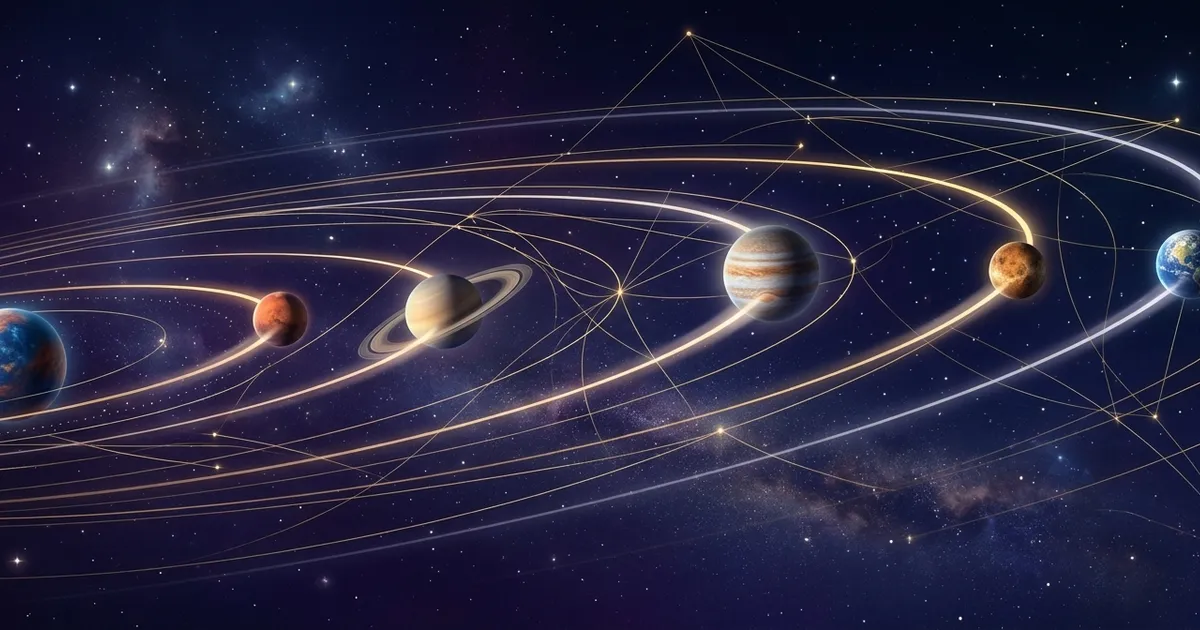
What Are Astrological Transits?
Astrological transits are the real-time positions of the moving planets as they form angles to the fixed points of your natal chart. As a planet "transits," it lights up a theme and a timing window in your chart, which astrologers read as a tool for reflection and self-awareness, never as a prediction of fixed events.
In other words, your natal chart is the still photograph of the sky at your birth, while astrological transits are the live broadcast happening overhead right now. Every planet keeps moving after you are born, and as it travels it eventually lines up with the planets and angles frozen in your chart. Those alignments are transits. They give astrology its sense of timing, helping you notice which areas of life feel emphasised in a given season. Because the slower planets move at very different speeds, some transits flicker past in hours while others colour several years of your life.
How Transits Activate the Natal Chart
A transit "activates" your chart when a moving planet forms an aspect, a meaningful angle, to one of your natal placements. Imagine your birth chart as a circular instrument with the planets fixed in place. As today's planets rotate around that circle, they periodically point directly at your natal Sun, Moon or a sensitive angle, and that contact is what astrologers interpret.
The closer the angle to exact, the stronger the theme tends to feel. This closeness is measured by the orb, the small range of degrees within which an aspect counts. A few key ideas:
- The natal placement sets the personal meaning (your Sun, Moon, Venus, and so on).
- The transiting planet sets the flavour of the season (Saturn brings structure, Jupiter brings expansion).
- The aspect sets the tone of the contact (smooth, tense, or blending).
- The house being transited points to the life area in focus.
Read together, these describe a symbolic prompt for reflection, not an instruction. A Saturn transit to your natal Moon, for example, might invite you to take your emotional needs seriously, rather than guaranteeing any particular outcome.
Fast Planets vs Slow Planets: Why Duration Matters
The single most useful idea in reading transits is planetary speed. Fast planets move quickly through the zodiac, so their transits are brief and frequent. Slow planets crawl, so their transits last far longer and tend to mark deeper, more memorable chapters.
| Planet | Speed | Typical transit feel |
|---|---|---|
| Moon | Very fast | Hours; passing moods |
| Mercury, Venus, Sun | Fast | Days; quick, everyday themes |
| Mars | Moderate | Days to weeks; drive and energy |
| Jupiter | Slow | Weeks to months; growth, openness |
| Saturn | Slow | Months; structure, responsibility |
| Uranus, Neptune, Pluto | Very slow | Months to years; long, formative shifts |
This is why a passing Moon transit rarely registers, while a slow Saturn or Pluto transit can define a whole period of your life. When you track your current transits, the slow-planet contacts are usually the headline; the fast ones are the day-to-day texture beneath them. Knowing the speed of the planet involved instantly tells you whether you are looking at a fleeting mood or a season worth reflecting on.
The Saturn Return Explained (~29, ~58 Years)
The Saturn return is the signature transit of a lifetime. According to NASA, Saturn completes a single orbit of the Sun in about 29.4 Earth years (10,756 days), so around ages 28 to 30, and again near 57 to 59, transiting Saturn returns to the exact degree it held in your natal chart. That astronomical period is what gives the return its regular, near-universal timing; astrologers then treat the moment as a symbolic threshold between life stages.
Symbolically, the Saturn return is a season of honest structural review. The themes Saturn governs, responsibility, commitment, career, maturity and long-term foundations, tend to come up for reassessment. Many people use this period to ask which structures in their life are genuinely theirs and which they have outgrown. The second Saturn return, near 58, often reframes the same questions in the light of legacy and what comes next.
It is worth being clear: a Saturn return is not a guaranteed crisis, nor a fixed event you must brace for. It is a reflective milestone. Used well, it is a structured invitation to take stock, set firmer foundations, and choose your commitments with more intention.
Major Life-Cycle Transits at a Glance
Because the outer planets move so slowly, their major transits arrive at broadly similar ages for everyone, which is why certain life stages feel almost universal. The table below summarises the classic life-cycle transits as reflective themes, not predictions.
| Transit | Approximate Age | Cycle Length | Reflective Theme |
|---|---|---|---|
| Jupiter Return | ~12 & ~24 yrs | ~12 yrs | Growth and expansion |
| Saturn Square | ~21 yrs | ~29 yrs cycle | First maturity test |
| Saturn Return | ~29 & ~58 yrs | ~29 yrs | Structural redefinition |
| Uranus Opposition | ~42 yrs | ~84 yrs | Midlife awakening |
| Chiron Return | ~50 yrs | ~50 yrs | Healing and integration |
The Uranus opposition near 42 is often described as a "midlife awakening," a season when the urge for freedom and authenticity grows louder. Its timing is no coincidence: NASA reports that Uranus takes about 84 Earth years (30,687 days) to circle the Sun, so it reaches the point directly opposite its natal position at roughly the halfway mark of that orbit, near age 42. The Chiron return near 50 invites reflection on old wounds and how far you have integrated them. None of these are fixed scripts; they are recurring symbolic seasons that many people find useful as prompts for honest self-inquiry. If you enjoy tracking these yearly cycles, a solar return chart offers a complementary lens on the themes of each new year.
Transit Aspects: Conjunction, Square, Opposition, Trine, Sextile
The aspect, the exact angle between a transiting planet and a natal point, sets the tone of the contact. The five major aspects each carry a recognisable quality, and they are the same angles used when reading a natal chart.
| Aspect | Angle | Typical Orb | Reflective Nature |
|---|---|---|---|
| Conjunction | 0° | ~6–8° | Blending, intensification |
| Sextile | 60° | ~3–4° | Gentle opportunity |
| Square | 90° | ~6° | Productive tension |
| Trine | 120° | ~6° | Easy, flowing support |
| Opposition | 180° | ~6–8° | Balance, awareness |
A conjunction fuses the two energies, so a transit feels concentrated. A trine or sextile tends to feel supportive and easy. A square or opposition describes friction, which is not "bad" so much as a call to grow or to find balance. When reading astrological transits, the aspect tells you how the season feels, while the planets and house tell you what it concerns and where it shows up.
Reading a Transit Timeline as a Reflective Tool
A transit timeline lists the active and upcoming aspects between today's planets and your natal chart, with their approximate dates. The temptation is to read it as a forecast of fixed events. A healthier and more accurate approach is to read it as a structured journaling prompt.
A simple practice:
- Note the slow-planet transits first. These set the major themes of the season.
- Read each transit as a question, not a verdict. "Where might I need more structure?" rather than "What bad thing will happen?"
- Watch for repeated themes. Several transits touching the same house or natal planet is more telling than any single contact.
- Reflect, then revisit. Write down what you notice, and check back as the transit fades.
Used this way, a timeline becomes a mirror for self-awareness. It can help you name what you are already feeling and choose how to respond, while leaving your free will, context and choices fully intact. It is not, and should not be treated as, a prediction of certain outcomes.
How to Track Your Current Transits with Astrollo
To track transits accurately you need two things: a precise natal chart and today's planetary positions. Astrollo calculates both using the Swiss Ephemeris, the same computation engine used across professional astrological software. Per its official documentation, the Swiss Ephemeris reproduces NASA JPL data to a precision of 0.001 arcseconds, so the underlying astronomy is accurate to a tiny fraction of a degree. That precision belongs to the mathematics of where the planets are, and nothing more. You can start by calculating your free natal chart, the fixed map that every transit is measured against.
Astrollo then compares the live sky to your birth chart and presents your current transits as a clear, dated timeline, highlighting which slow-planet seasons are active and which fast contacts are passing through. Interpretations are written to inform reflection rather than to make guarantees. As with the rest of astrology, this is a tool for self-reflection and insight, not a science of prediction. It does not diagnose or treat any health or mental-health condition, forecast your finances, or determine relationship, family or legal outcomes, and it never replaces professional medical, psychological, financial or legal advice.
Common Misconceptions About Transits
A few myths get in the way of using transits well:
- "Transits predict fixed events." They describe symbolic themes and timing windows, not certainties.
- "Hard aspects are bad, soft aspects are good." Squares and oppositions often drive the most meaningful growth; easy trines can pass unnoticed.
- "Every transit matters equally." A two-hour Moon transit is not in the same league as a two-year Pluto transit.
- "My transits override my choices." They highlight seasons; you decide how to respond.
- "You need to fear the Saturn return." It is a milestone for honest review, not a sentence.
Seen clearly, astrological transits are simply a way of adding timing to the symbolism you already explore in your natal chart, turning a static map into a living, reflective tool.
Ready to see the sky in motion over your own chart? Calculate your free natal chart with Astrollo and start reading your current transits as a thoughtful, reflective timeline.
Sources
- NASA Science — Saturn Facts: orbital period of about 29.4 Earth years (10,756 days).
- NASA Science — Uranus Facts: orbital period of about 84 Earth years (30,687 days).
- Swiss Ephemeris (astro.com) — Technical overview: reproduces NASA JPL data to a precision of 0.001 arcseconds.