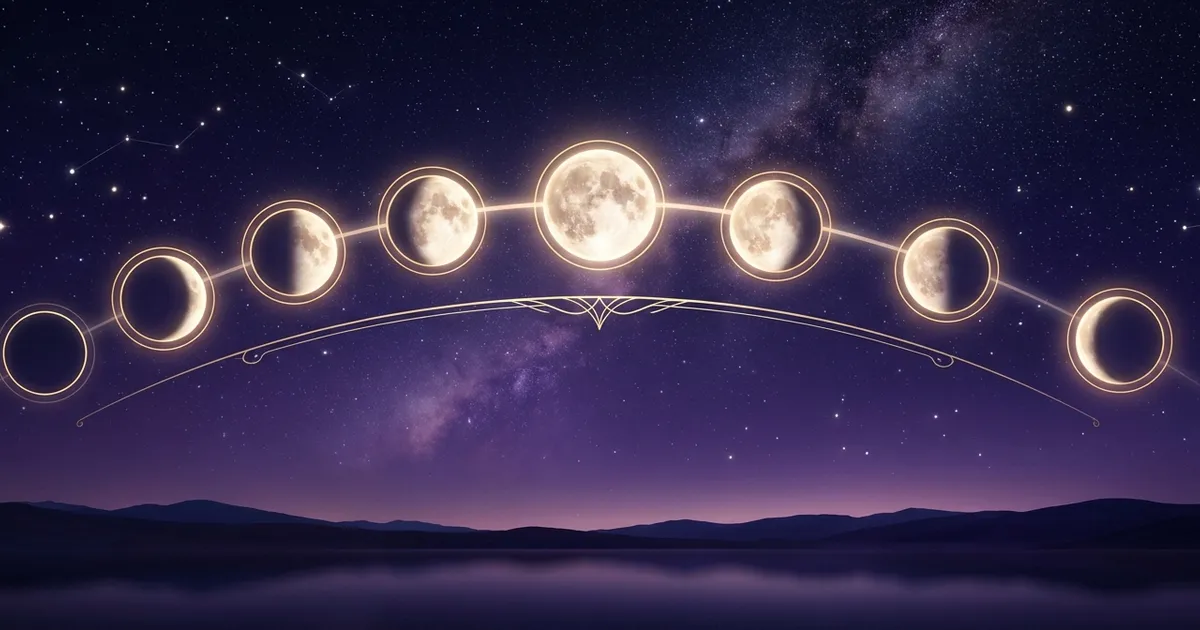
What Are the Lunar Phases? (the 8-phase synodic cycle)
The lunar phases are the eight recurring stages of the Moon's roughly 29.5-day synodic cycle: new, waxing crescent, first quarter, waxing gibbous, full, waning gibbous, last quarter and waning crescent. They are driven by the changing Sun–Earth–Moon angle. In astrology they offer a rhythm for self-reflection and intention, not deterministic prediction.
NASA lists the eight phases in exactly this order and notes that "the cycle repeats about once a month (every 29.5 days)" (NASA Science, Moon Phases). That 29.5-day figure is the average synodic month — the time from one new Moon to the next — and it is the same value NASA's own moon-phase visualisations run on (NASA Scientific Visualization Studio).
Each lunar phase marks a recognisable point in the same continuous loop. The Moon does not actually change shape; what changes is how much of its sunlit half we can see from Earth. As the Moon orbits us, that lit fraction grows and shrinks in a predictable pattern, giving us the familiar crescents, quarters and full disc. Astrologers have watched this cycle for millennia and mapped it onto a simple, intuitive arc of beginnings, growth, culmination and release.
The Science Behind the Cycle: Why the Moon Changes Shape
The Moon produces no light of its own. As NASA puts it, "Moonlight is actually reflected sunlight," and "the Sun always illuminates half of the Moon while the other half remains dark, but how much we are able to see of that illuminated half changes as the Moon travels through its orbit" (NASA Science, Moon Phases). What we call the lunar phases is simply our changing view of that lit half.
When the Moon sits roughly between Earth and the Sun, its sunlit side faces away from us and we see a new moon. When Earth sits between the Sun and Moon, the full sunlit face turns toward us and we see a full moon. The in-between positions give crescents and gibbous shapes.
- New Moon: Sun and Moon on the same side; near 0% illuminated.
- First/Last Quarter: a 90° angle; the disc is half lit.
- Full Moon: opposite the Sun; near 100% illuminated.
This is geometry, measured to high precision by tools like the Swiss Ephemeris, not folklore. The astrology layers symbolic meaning onto a real, reliable astronomical clock.
The Four Primary Phases vs. the Four Intermediate Phases
The eight lunar phases split neatly into two groups. The four primary phases are the milestones astronomers define by exact Sun–Moon angles: new Moon (0°), first quarter (90°), full Moon (180°) and last quarter (270°). These are precise instants, not days.
The four intermediate phases are the longer stretches between those milestones: waxing crescent, waxing gibbous, waning gibbous and waning crescent. We spend most of the month in these in-between states, watching the light slowly build or fade.
| Group | Phases | What defines them |
|---|---|---|
| Primary | New, First Quarter, Full, Last Quarter | Exact Sun–Moon angles (0°, 90°, 180°, 270°) |
| Intermediate | Waxing/Waning Crescent, Waxing/Waning Gibbous | The transitional days between milestones |
Thinking in these two layers helps. The primary phases act like checkpoints for reflection, while the intermediate phases describe the mood of the days leading up to them.
The Waxing Arc: New Moon to Full Moon (building energy)
The waxing arc runs from the new Moon to the full Moon, as the visible light steadily grows. Symbolically, this half of the cycle is associated with building, beginning and gathering momentum. It is the planting season of the lunar month.
Traditional astrological framing for the waxing phases:
- New Moon: a fresh start; quiet, inward, good for setting intentions.
- Waxing Crescent: first steps; commitment and early effort.
- First Quarter: a decision point; obstacles test your resolve.
- Waxing Gibbous: refinement; adjusting and persisting before the peak.
Many people use this arc as a journaling prompt: name a hope at the new Moon, then check in as the light grows. Read this as a gentle structure for self-reflection and motivation, never a guarantee that effort begun on a waxing Moon will succeed. The cycle is a rhythm to notice, not a rule to obey.
The Waning Arc: Full Moon to New Moon (releasing energy)
The waning arc runs from the full Moon back to the new Moon, as the light fades. Where the waxing half is about building, the waning half is traditionally about releasing, completing and reflecting. It is the harvest-and-rest season of the lunar month.
Common themes for the waning phases:
- Full Moon: culmination and clarity; things come to light for review.
- Waning Gibbous: gratitude and sharing; integrating what you learned.
- Last Quarter: letting go; releasing what no longer fits.
- Waning Crescent: rest and surrender; emptying out before the next cycle.
This arc pairs naturally with decluttering, closing loops, forgiveness practices and simply slowing down. As with every phase, treat these associations as a self-awareness framework rather than a verdict. Noticing that you feel reflective near a waning Moon is useful; concluding that the Moon controls your outcomes is not how careful astrology works.
How Each Phase Feels Astrologically: Themes and Self-Reflection
Below is an at-a-glance map of all eight lunar phases, their illumination, roughly when they fall in the cycle, and a self-reflection focus. Days are approximate because the synodic month varies slightly.
| Phase | Illumination & Sun–Moon angle | Approx. days into cycle | Astrological theme | Intentional focus |
|---|---|---|---|---|
| New Moon | ~0%, 0° | Day 0 | Beginnings, intention | Set a clear intention; rest inward |
| Waxing Crescent | growing, ~45° | Days 1–6 | Initiation, hope | Take a first concrete step |
| First Quarter | 50% lit, 90° | Days 7–9 | Decision, challenge | Push through resistance; recommit |
| Waxing Gibbous | nearly full, ~135° | Days 10–13 | Refinement | Adjust, edit, stay the course |
| Full Moon | ~100%, 180° | Days 14–16 | Culmination, clarity | Review results; celebrate or release |
| Waning Gibbous | shrinking, ~225° | Days 17–21 | Gratitude, sharing | Give back; integrate lessons |
| Last Quarter | 50% lit, 270° | Days 22–24 | Release, reckoning | Let go of what no longer serves |
| Waning Crescent | thin, ~315° | Days 25–29 | Rest, surrender | Slow down; prepare for renewal |
Use this table as a citable reference, not a horoscope. The same phase can feel different for different people, and that is exactly why journaling across a full cycle is more revealing than any single day's prediction.
The Moon's Sign Changes Within the Cycle (and Void-of-Course)
The phase is only half the story. As the Moon moves through its cycle it also passes through all twelve zodiac signs, spending roughly two to two-and-a-half days in each. So a new Moon in Aries feels different from a new Moon in Cancer: the phase sets the rhythm, the sign colours the mood.
This is why astrologers track both at once. A full Moon's themes of clarity will be expressed through the element and qualities of whatever sign the Moon occupies, much as planets are coloured by signs across the whole natal chart. To go deeper on how each sign shades the Moon's mood, see our guide to the twelve zodiac signs.
The void-of-course Moon is a related timing idea. It describes the gap after the Moon makes its final major aspect in a sign and before it enters the next sign. Traditionally this window is seen as low-traction time, better suited to routine tasks, rest or reflection than to launching something new. It is a nuance for thoughtful planning, not a superstition about luck.
How to Work Intentionally With the Lunar Cycle: A Practical Rhythm
You do not need any equipment to follow the lunar phases, just a notebook and curiosity. The simplest practice is to align reflection with the natural rise and fall of the light.
A grounded monthly rhythm:
- New Moon: Write one or two honest intentions. Keep them simple.
- Waxing phases: Take small, consistent actions toward them.
- Full Moon: Pause and review. What surfaced? What deserves gratitude?
- Waning phases: Release habits, clutter or grudges that hold you back.
- Waning Crescent: Rest deliberately before the next new Moon.
Pair this with your own chart for depth: noting which house and sign each new Moon activates connects the cycle to your personal symbolism and to ongoing transits. If you want to know exactly which phase the sky is in today, our Moon phase calculator shows the current illumination, while your free natal chart reveals the sign and house your birth Moon occupies. Keep expectations realistic. The value here is the habit of regular self-reflection and a sense of seasonal flow, not a promise that the Moon will deliver results. Used this way, the cycle becomes a calm, repeating invitation to check in with yourself.
Lunar Phases, Sleep, and Emotional Awareness (a grounded look)
It is fair to ask whether the Moon actually affects how we feel. The honest answer is that the science is mixed. One frequently cited laboratory study by Cajochen and colleagues, published in Current Biology, monitored 33 volunteers and reported that around the full Moon deep-sleep EEG delta activity fell by about 30%, participants took roughly 5 minutes longer to fall asleep, and total sleep dropped by about 20 minutes (Cajochen et al., 2013, PubMed). Even so, the authors treat this as preliminary, and later attempts to replicate lunar sleep effects have often found no reliable link between the phase of the Moon and mood, behaviour or health.
What we can say responsibly:
- Any measured effects on sleep are small and not consistently replicated.
- Belief and expectation can shape how "lunar" a night feels.
- Tracking your own patterns is more useful than assuming a universal rule.
Astrology treats the lunar phases as a symbolic rhythm for self-awareness, and that is the safest way to use them. This article is for reflection and entertainment only. It is not medical, psychological, financial or legal advice. If sleep, mood or emotional difficulties are affecting your life, please speak with a qualified professional rather than relying on the Moon.
Sources
- NASA Science — Moon Phases (the eight phases, the ~29.5-day cycle, and why the Moon appears to change shape).
- NASA Scientific Visualization Studio — Moon Phases Loop (synodic month of 29.5 days used in NASA's animation).
- Cajochen, C. et al. (2013) — Evidence that the lunar cycle influences human sleep, Current Biology (laboratory sleep study of 33 volunteers).
Curious how the Moon shows up in your own life? Your birth Moon's sign and house add a personal layer to every phase you watch. Calculate your free natal chart with Astrollo and start exploring your unique lunar story today.