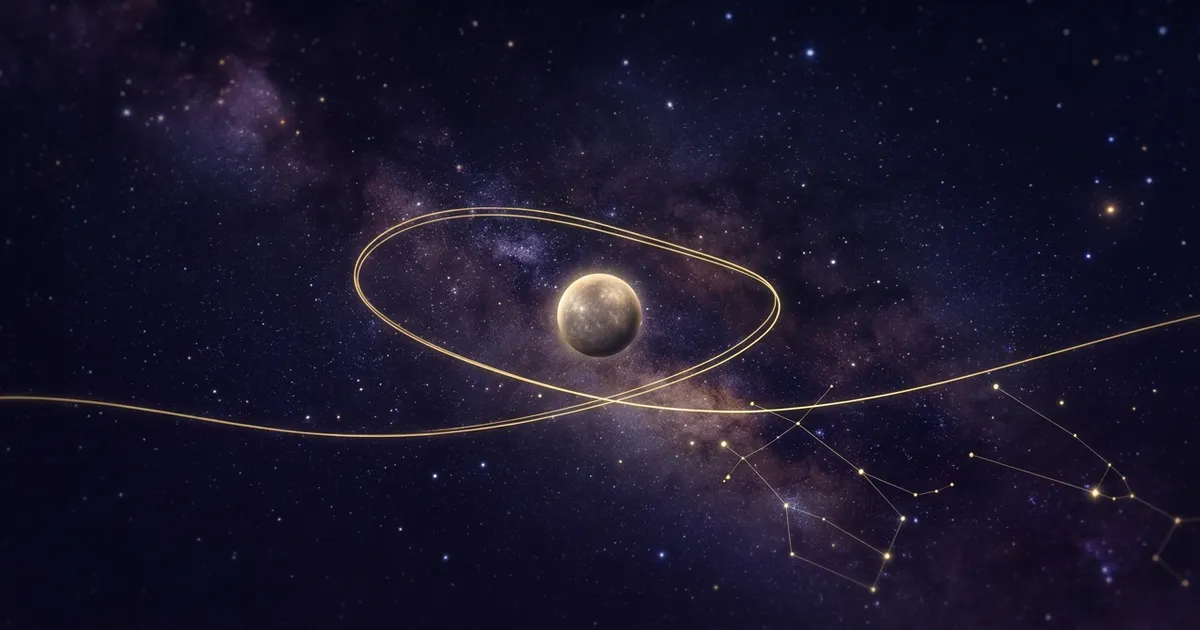
What is Mercury retrograde?
Mercury retrograde is an apparent (not real) backward motion of Mercury, caused by Earth and Mercury orbiting the Sun at different speeds — an optical illusion confirmed by astronomy. It happens three to four times a year for roughly three weeks each, and astrology links it to reviewing communication, technology and travel: a reflective tool, not a forecast of doom.
What Mercury Retrograde Actually Is (Apparent vs. Real Motion)
The crucial word is apparent. During Mercury retrograde, the planet never truly reverses course or slows down in its orbit. What changes is our viewpoint from a moving Earth. Just as a faster car on the inside lane seems to surge ahead and then, against the distant scenery, swing backward as it sweeps past you, Mercury appears to trace a backward loop against the background stars when it overtakes Earth on its inner orbit.
This distinction matters because it separates the astronomy from the symbolism. The astronomy is settled and measurable: Mercury keeps moving forward the entire time. Astrology, meanwhile, treats the observable retrograde cycle as a meaningful rhythm — a recurring invitation to slow down and review. Throughout this article we keep those two layers honest and distinct:
- The fact: an optical illusion produced by orbital mechanics.
- The meaning: a symbolic season of reflection that astrology has tracked for centuries.
Holding both at once lets you enjoy the tradition without mistaking it for physics.
The Astronomy Behind the Illusion: Why Mercury Seems to Reverse
Mercury is the closest planet to the Sun and the fastest in the solar system, completing an orbit in about 88 days. Earth takes 365. Because both planets travel at different speeds along curved paths, there are moments when faster Mercury, swinging along its inner orbit, catches up to and overtakes Earth — passing roughly between us and the Sun. In those weeks Mercury seems to halt, slide backward, halt again, then resume forward motion.
This is apparent retrograde motion, and every planet displays it from our perspective. It is purely a line-of-sight effect. NASA is blunt about it: retrograde motion "is an APPARENT change in the movement of the planet through the sky… It is not REAL in that the planet does not physically start moving backwards in its orbit" (NASA StarChild). For an inner planet, the reversal is tied to inferior conjunction — the moment Mercury passes between Earth and the Sun (Wikipedia: Apparent retrograde motion). Telescopes, spacecraft tracking and the Swiss Ephemeris all confirm Mercury's steady prograde orbit; the "reversal" exists only in the two-dimensional path we observe against the stars. If you want to see where Mercury actually sits right now, our natal chart calculator plots its true position to a fraction of a degree.
| Phase | What is happening | What we see |
|---|---|---|
| Direct (prograde) | Mercury moving its normal way | Eastward drift through the zodiac |
| Station retrograde | Mercury begins to overtake Earth | Mercury appears to pause |
| Retrograde | Mercury passing between Earth and Sun | Apparent backward loop |
| Station direct | Geometry realigns | Mercury appears to pause again |
Understanding the geometry removes the mystique while keeping the cycle beautifully predictable.
How Often It Happens and How Long It Lasts (Plus Shadow Periods)
Mercury retrograde is frequent and rhythmic, which is part of why it became so famous. It occurs roughly three to four times per year, and each retrograde lasts about three weeks. The reason is orbital speed: as The Planetary Society explains, "Mercury only takes 88 days to orbit the Sun compared to Earth's 365," so "it overtakes us in this way three to four times a year, appearing to move backwards for about three weeks at a time" (The Planetary Society). Because Mercury hugs the Sun, these periods recur with reassuring regularity.
There is a wider window most people miss: the shadow period. Before Mercury stations retrograde, it passes through the band of zodiac degrees it will later re-cross; after it stations direct, it travels that band a third time. Astrologers call these the pre- and post-retrograde shadows, and they extend the broader cycle by a couple of weeks on each side.
- Pre-shadow: Mercury first crosses the degrees it will revisit.
- Retrograde proper: roughly three weeks of apparent backward motion.
- Post-shadow: Mercury re-covers the same degrees moving forward.
Counting the shadows, the full arc can span six to eight weeks. Exact start and end dates change every year and should always be taken from precise ephemeris calculations rather than memory.
What Astrology Associates With Mercury Retrograde: Communication, Tech, Travel & Review
In astrology, Mercury rules thinking, speech, messages, short journeys, devices and the small daily logistics that keep life running. So when Mercury turns retrograde, the symbolism turns inward and backward: a season for re-doing rather than launching. The keyword is the prefix "re-" — review, revise, reconsider, reconnect.
The table below reframes the cycle as an invitation to look again at familiar areas — not as a list of dangers.
| Domain | Common Theme | Reflective Prompt | Honest Caveat |
|---|---|---|---|
| Communication | Crossed wires, unclear messages | Revise and re-read before sending | No guaranteed misunderstanding |
| Technology & Devices | Glitches, lost files | Back up and update proactively | Tech fails year-round, not just now |
| Travel & Logistics | Delays, mix-ups | Re-check times and bookings | Delays are not caused by a planet |
| Contracts & Decisions | Fine print, second thoughts | Reconsider terms before signing | You can still sign if needed |
| Past & Relationships | Old contacts resurface | Reconnect or reflect, gently | Reappearance is coincidence, not fate |
Used this way, the period becomes a structured nudge toward care and reflection rather than a source of anxiety.
Myths vs. Reality: Separating Folklore From an Honest Take
Popular culture has turned Mercury retrograde into a scapegoat for every spilled coffee and dropped call. An honest astrology distinguishes folklore from a thoughtful, non-deterministic reading.
- Myth: "Never sign contracts or buy electronics." Reality: life continues; the cycle simply suggests reading carefully and double-checking — sensible advice in any month.
- Myth: "It causes technology to break." Reality: devices fail in every season. The retrograde label makes us notice and attribute failures more — a classic confirmation bias.
- Myth: "Exes always come back." Reality: old contacts reappear year-round; the frame just makes the pattern feel meaningful.
- Myth: "It's astronomically impossible, so it's nonsense." Reality: the motion is genuinely apparent, and astrology never claimed Mercury physically reverses.
The grounded view: Mercury retrograde is a real, observable cycle with symbolic meaning attached. It can support reflection, but it does not control events, dictate outcomes, or override your choices.
Mercury Retrograde in Your Natal Chart (and by House)
Roughly one in five people are born during a Mercury retrograde, so a natal Mercury retrograde is common and entirely neutral. Symbolically, it suggests an inward, reflective thinking style: someone who turns ideas over privately before speaking, who may revisit and refine thoughts, and who often communicates with depth once they have processed. It says nothing about intelligence or ability.
The house where your natal Mercury sits colours where that reflective style shows up most:
- 3rd or 6th house: an analytical, detail-revising mind in daily work and learning.
- 7th house: a tendency to reconsider and re-read relationship dynamics.
- 10th house: a thoughtful, edit-as-you-go approach to career and public voice.
Treat any placement as a mirror for self-understanding, not a label. Your natal chart is one lens among many, and a reflective Mercury can be a genuine strength when you lean into careful, considered communication. If you'd like to see how a live retrograde interacts with your birth placements, our guide to transits explains how moving planets touch the natal chart.
How to Work With the Period: A Practical, Non-Deterministic Approach
You do not need to put life on hold. The most useful approach treats Mercury retrograde as a gentle systems-check — a built-in reminder to tidy the parts of life Mercury governs.
- Back up and update. Save important files and update devices before the period starts.
- Slow your communication. Re-read emails and messages; confirm details twice rather than assuming.
- Build in buffer time. Allow extra margin for travel and appointments to reduce stress from ordinary delays.
- Review, don't launch. It is a fine time to revise drafts, revisit goals, and reconnect — and you can still start new things if needed.
- Reflect, then act. Use the season for journaling or reconsidering decisions, while keeping your own judgement firmly in charge.
This is reflective guidance, not a set of rules — and it is not financial, legal, medical or psychological advice. If a decision carries real stakes, consult a qualified professional regardless of any planetary cycle.
Finding Exact Dates With Swiss Ephemeris Precision
Because Mercury retrograde dates shift every year, accuracy matters. The stationary points — when Mercury appears to pause before and after retrograde — are calculated from the Swiss Ephemeris, the same high-precision astronomical data professional astrologers rely on. Astrollo computes planetary positions to an engine precision of 0.001°, so the astronomy behind the dates is exact to a tiny fraction of a degree.
That precision belongs purely to the mathematics of where Mercury is, and nothing more. The interpretation layered on top remains symbolic: a tool for reflection and self-awareness, never a guaranteed prediction of events. Knowing the exact window simply lets you plan your reviews — backups, re-reads, reconnections — with confidence, instead of guessing.
When you see a Mercury retrograde date, remember the two layers we have kept distinct throughout: a settled astronomical fact, and an optional, non-deterministic invitation to slow down and look again.
Curious where Mercury sits in your own sky? Calculate your free natal chart with Astrollo to see your personal Mercury placement — by sign and house — and explore whether you were born during a Mercury retrograde, using the same Swiss Ephemeris precision described above.
Sources
- NASA StarChild — What does it mean for Mercury to be in retrograde? — retrograde is an apparent, not real, change in a planet's motion.
- The Planetary Society — What does "Mercury in retrograde" actually mean? — Mercury's 88-day orbit, ~three to four retrogrades a year lasting about three weeks each.
- Wikipedia — Apparent retrograde motion — how inferior planets retrograde around inferior conjunction.